WordPress Ad Banner

Google Upgrades Bard to Compete with ChatGPT

In November 2022, OpenAI unleashed ChatGPT, setting a benchmark for conversational AI. Since then, Google has been playing catch-up with its own tool, Bard. However, at the Google I/O conference, Google Upgrades Bard to Compete with ChatGPT.

Initially launched with limited availability and a waitlist, Bard encountered challenges in gaining traction. Now, Google is removing the waitlist and opening Bard to a global audience, aiming to broaden its reach and impact.

Google also unveiled several advancements to outpace ChatGPT, including multi-language support, visual responses, export functionality, and new integrations. These enhancements are designed to provide users with an enhanced and more versatile conversational AI experience.

During a Google I/O keynote, Sissie Hsiao, VP and GM of Google Assistant and Bard, highlighted the transformative impact of large language models and the team’s dedication to rapid improvement and iterative development of Bard.

With these updates, Google aims to position Bard as a competitive alternative to ChatGPT, leveraging its own advancements and capabilities in the field of conversational AI.

The term “bard” is a word used to describe a storyteller and is a moniker that is also commonly associated with famous English playwright William Shakespeare.

Bard’s words aren’t written by Shakespeare, or any other human (at least, not directly), but rather are generated from Google’s newest large language model (LLM) PaLM 2, which was also announced at today’s Google I/O event. 

PaLM 2 provides Bard with significantly enhanced generative AI capabilities that exceed the initial functionality that Bard launched with earlier this year.

“With PaLM 2, Bard’s math, logic and reasoning skills made a huge leap forward, underpinning its ability to help developers with programming,” Hsiao said. “Bard can now collaborate on tasks like code generation, debugging and explaining code snippets.”

With code generation, Bard is also going a step further in its bid to help outpace OpenAI’s capabilities. Hsiao said that starting next week, Bard will integrate precise code citations to help developers understand exactly where code snippets have come from.

What good is a Bard if you can’t share its work? 

Another limitation of the original Bard was that responses and generated content remained in Bard, but that’s also about to change.

Hsiao announced that, starting today, Bard is adding export actions for Gmail and Google Docs, making it easy to integrate generated content. Going a step further, she announced that more extensibility is coming to Bard with the launch of tools and extensions. 

“As you collaborate with Bard, you’ll be able to tap into services from Google and extensions with partners to let you do things never before possible,” Hsiao said.

Bard going multilingual

English isn’t the only language that Google’s users speak and soon it won’t be the only language that Bard supports either.

The plan is for Bard to support 40 different languages, starting today with Japanese and Korean, with more to come in the following months.

“It’s amazing to see the rate of progress so far with more advanced models. So many new capabilities and the ability for even more people to collaborate with Bard,” Hsiao said.

Informatica Goes All In on Generative AI with Claire GPT

Informatica, a known provider of end-to-end data management solutions, today debuted Claire GPT, a generative AI tool to simplify different aspects of data handling.

Announced at the company’s annual conference in Las Vegas, the offering allows enterprise users to consume, process, manage and analyze data through plain natural language prompts. It will be integrated with Informatica’s Intelligent Data Management Cloud (IDMC) and begin to roll out in the second half of 2023. 

The news comes as leading industry vendors, including many in the data space, continue to look at large language models (LLMs) as a way to make their products accessible to a broader spectrum of users.

Interact with data via natural language

Effective data management is essential for business success, but given the tsunami of data that enterprises have, manual approaches to managing data are no longer relevant. They take a lot of time, resources and effort. Plus, not every individual within the organization has the technical know-how for the job.

Claire GPT from Informatica aims to address this gap with a text-to-IDMC interface where users can enter simple natural language prompts to discover, interact with and manage their data assets.

Claire GPT
Claire GPT. Image source: Informatica.

While the solution is yet to roll out widely, the company says it will support multiple jobs within the IDMC platform, including data discovery, data pipeline creation and editing, metadata exploration, data quality and relationships exploration, and data quality rule generation. 

“It leverages a multi-LLM architecture, using public LLMs for non-sensitive queries (like intent classification, where we use LLMs to identify the user intent — metadata exploration, data exploration, pipeline creation, etc.) and fine-tuned Informatica-hosted LLMs that generate data management artifacts,” Amit Walia, CEO of Informatica, told VentureBeat. He claims that the solution can help experienced data users, such as engineers, analysts and scientists, realize up to an 80% reduction in time spent on key data management tasks.

Pairing with Claire

Informatica has designed the new conversational experience of data management by pairing its enterprise-scale AI engine Claire with GPT capabilities. Claire processes 54 trillion transactions on a monthly basis, which ensures that the answers produced by the chatbot are grounded in reality and not hallucinating.

“Ask ChatGPT to help you design and script a data pipeline, and it will. But that pipeline might not work. The problem is that LLMs in themselves lack any semblance of governance. They are black boxes that dodge questions about lineage. They emit errors and make things up. So, to really capture the productivity benefits of LLMs in a consistent way, you must put [them] in a governed setting. Pairing GPT capabilities with Informatica’s Claire platform creates the possibility that data teams can improve productivity with AI while maintaining governance and control,” Kevin Petrie, vice president of research at Eckerson Group.

Notably, Informatica is not the only player leveraging generative AI in such a way. Salesforce recently launched SlackGPT, combining Slack’s internal knowledge with LLMs, while observability major New Relic has launched Grok, an AI assistant for monitoring software for performance issues and fixing them.

What’s more at Informatica World?

Along with Claire GPT, Informatica also debuted new Claire-driven data management capabilities, including inferred data lineage, autogenerated classifications, multicolumn completeness analysis and automapping.

The company also took to the stage to announce IDMC for Environmental, Social and Governance, as well as “Cloud Data Integration for PowerCenter (CDI-PC)” to help customers migrate on-premises PowerCenter assets to IDMC. With the CDI, Informatica claims, enterprises will be able to move to the cloud up to six times faster, reuse 100% of PowerCenter artifacts and assets in the cloud, and realize anticipated cost savings of up to 20 times. 

Claire GPT is currently in the private preview stage and is expected to see a wider rollout in the second half of 2023. The same goes for CDI-PC.

Google Opens Up About PaLM 2, Its New Generative AI LLM

Google has commenced its annual I/O conference with a strong emphasis on advancing artificial intelligence (AI) across its various domains, with a particular spotlight on PaLM 2.

Google I/O has traditionally served as a developer conference, covering a wide range of topics. However, this year’s event stands out as AI takes center stage in almost every aspect. Google aims to establish itself as a frontrunner in the market, even as competitors like Microsoft and OpenAI enjoy the success of ChatGPT.

The cornerstone of Google’s endeavors is its newly introduced PaLM 2, a large language model (LLM). PaLM 2 will provide the backbone for at least 25 Google products and services, which will be extensively discussed in sessions at I/O. These include Bard, Workspace, Cloud, Security, and Vertex AI.

Originally launched in April 2022, the initial version of PaLM (Pathways Language Model) served as Google’s foundational LLM for generative AI. According to Google, PaLM 2 significantly enhances the company’s generative AI capabilities in meaningful ways.

During a roundtable press briefing, Zoubin Ghahramani, VP of Google DeepMind, emphasized Google’s mission to make information universally accessible and useful. He highlighted how AI has accelerated this mission, providing opportunities to gain a deeper understanding of the world and create more helpful products.

As Google showcases PaLM 2 and its far-reaching implications at the I/O conference, it solidifies its commitment to advancing AI and harnessing its potential to improve user experiences and product functionality.

Putting state-of-the-art AI in the ‘palm’ of developers’ hands with PaLM 2

Ghahramani explained that PaLM 2 is a state-of-the-art language model that is good at math, coding, reasoning, multilingual translation and natural language generation. 

He emphasized that it’s better than Google’s previous LLMs in nearly every way that can be measured. That said, one way that previous models were measured was by the number of parameters. For example, in 2022 when the first iteration of PaLM was launched, Google claimed it had 540 billion parameters for its largest model. In response to a question posed by VentureBeat, Ghahramani declined to provide a specific figure for the parameter size of PaLM 2, only noting that counting parameters is not an ideal way to measure performance or capability.

Ghahramani instead said the model has been trained and built in a way that makes it better. Google trained PaLM 2 on the latest Tensor Processing Unit (TPU) infrastructure, which is Google’s custom silicon for machine learning (ML) training. 

PaLM 2 is also better at AI inference. Ghahramani noted that by bringing together compute, optimal scaling and improved dataset mixtures, as well as improvements to the model architectures, PaLM 2 is more efficient for serving models while performing better overall.

In terms of improved core capabilities for PaLM 2, there are three in particular that Ghahramani called out:

Multilinguality: The new model has been trained on over 100 spoken-word languages, which enables PaLM 2 to excel at multilingual tasks. Going a step further, Ghahramani said that it can understand nuanced phrases in different languages including the use of ambiguous or figurative meanings of words rather than the literal meaning.

Reasoning: PaLM 2 provides stronger logic, common sense reasoning, and mathematics than previous models. “We’ve trained on a massive amount of math and science texts, including scientific papers and mathematical expressions,” Ghahramani said.

Coding: PaLM 2 also understands, generates and debugs code and was pretrained on more than 20 programming languages. Alongside popular programming languages like Python and JavaScript, PaLM 2 can also handle older languages like Fortran.

“If you’re looking for help to fix a piece of code, PaLM 2 can not only fix the code, but also provide the documentation you need in any language,” Ghahramani said. “So this helps programmers around the world learn to code better and also to collaborate.”

PaLM 2 is one model powering 25 applications from Google, including Bard

Ghahramani said that PaLM 2 can adapt to a wide range of tasks, and at Google I/O the company has detailed how it supports 25 products that impact just about every aspect of the user experience.

Building off the general-purpose PaLM 2, Google has also developed the Med-PaLM 2, a model for the medical profession. For security use cases, Google has trained Sec-PaLM. Google’s ChatGPT competitor, Bard, will now also benefit from PaLM 2’s power, providing an intuitive prompt-based user interface that anyone can use, regardless of their technical ability. Google’s Workspace suite of productivity applications will also get an intelligence boost, thanks to PaLM 2.

“PaLM 2 excels when you fine-tune it on domain-specific data,” Ghahramani said. “So think of PaLM 2 as a general model that can be fine-tuned to achieve particular tasks.”

Tray.io Launches Merlin AI to Automate Complex Workflows Without LLM Training

Low-code automation and integration platform Tray.io today announced the launch of Merlin AI, a natural language automation feature on its platform. With Merlin AI, large language models (LLMs) can be transformed into complete business processes without exposing customer data to LLMs or mandating LLM training.

Merlin AI empowers employees and developers to construct, refine and enhance workflows without requiring IT or engineering participation, reducing integration time from weeks or months to minutes. The Tray.io platform merges the potency of adaptable, expandable automation, the provision of sophisticated business logic, and built-in generative AI capabilities to generate automated workflows.

“Merlin AI leverages OpenAI models and works seamlessly with Tray.io’s connector, workflow and API technologies, as well as other platform capabilities, to automatically translate natural language inputs — prompts or requests written in plain English — into sophisticated workflows,” Rich Waldron, cofounder and CEO at Tray.io, told VentureBeat. “Anyone can use Merlin to develop fully baked workflows to execute day-to-day tasks or retrieve information for specific business questions. It completely removes the learning curve for building automated workflows.”

The Tray.io platform’s generative AI capabilities, together with data transformation, authentication mechanisms, and backing for advanced business logic, allow users to construct comprehensive integrations with natural language processing (NLP). In addition, Merlin AI can automate intricate tasks, including aggregating or transferring data across systems, constructing automated workflows and addressing inquiries.

The company claims that the Tray platform is the first iPaaS (integration-platform-as-a-service) solution to provide generative AI capabilities accessible to all users.

“No other iPaaS on the market has native generative AI capabilities that anyone can use to securely automate complex business processes,” Alistair Russell, co-founder and CTO at Tray.io, told VentureBeat. “Unlike other applications that interface with LLMs, the operational capabilities of Merlin and the underlying Tray platform are self-contained, meaning Merlin only needs to fetch small pieces of information from the LLM on an as-needed basis during the integration building process. As a result, customer data is never exposed or sent to the LLM.”

The company said that Merlin employs a blend of GPT models, comprising GPT-3.5, GPT-4, Whisper and others, to handle distinct components of the natural language automation flow.

“Each of the models provides varying levels of capabilities, speed, and fine-tuning, which Merlin selects to ensure the best user experience,” said Russell.

Streamlining complex workflows through generative AI 

The company believes that Merlin AI’s release marks the beginning of a new age in automation, given that it eliminates IT and engineering participation requirements. This not only liberates those teams to concentrate on other imperatives, but increases the tempo of innovation.

“Merlin … increases the pace of innovation because your line-of-business teams are no longer relying on scarce technical resources,” Russell told VentureBeat. “What makes Merlin so valuable compared to LLMs alone is that it can act on the query outputs. Merlin is giving the LLM ‘brain’ a Tray ‘body,’ which can take action on the query and build the integration required to complete the business process. It does this without passing customer data back to the LLM and requires no further training to execute complex business tasks.”

Furthermore, the system operates throughout the customer’s entire software stack.

“This is very different to most GPT-related chatbot announcements that, at best, will only be able to take pre-defined actions within its application,” said Russell.

Merlin AI empowers users to automate intricate workflows in two ways. First, through conversation, Merlin can construct and refine sophisticated automation among multiple systems. For instance, by taking natural language inputs, such as a plea to append a novel data enrichment source to a lead lifecycle management process, Merlin can identify the appropriate connector from the Tray connector library, provoke the requisite authentications, execute the query, and ensure that the outcomes are properly incorporated in the process’s progression.

Second, Merlin AI can perform assignments on a user’s behalf without directly interacting with the workflows, establishing an entirely new interface for resolving business problems.

“In this case, a CMO seeking to optimize social media investments can directly query Merlin to identify the top lead sources for the largest ‘closed won’ accounts by revenue and cross-reference the results with LinkedIn followers. The CMO never needs to see the complexity of the integrations that Merlin is building on the Tray platform; they simply get the data they need to make a more informed business decision,” said Tray.io’s Waldron.

The company clarified that it does not send customer data through a third-party LLM. Instead, the LLMs are used to create workflows that can be executed within the Tray.io platform entirely, ensuring that no data is exposed or shared with the LLM.

Leveraging Open AI models to enhance iPaaS

The company explained that Merlin enhances the OpenAI LLM by acting on its output, and claims that while LLMs can provide intelligent responses to questions rapidly, they do not take any action once they have responded.

“The burden is immediately returned to the person who asked the question, and it is their responsibility to take often complex actions on the response to achieve the desired outcome. Merlin can take that response and carry out the action on the user’s behalf,” said Waldron. “With the release of Merlin, Tray.io is the first iPaaS offering with generative AI that anyone, regardless of their technical expertise, can use to automate complex workflows.”

The Tray platform incorporates contemporary technology standards, enabling LLMs to code without requiring a comprehensive understanding of the platform or any Tray connectors. This crucial capability allows any user, including the integration builder, to leverage the potential of AI. Moreover, as Merlin constitutes a fundamental aspect of the Tray platform, a product not designed in this manner would face considerable difficulties replicating this experience.

“Tray.io provides a suite of powerful automation infrastructure accessible via APIs and low-code, coupled with the fact that Merlin AI is core to the Tray platform. Merlin can tap into Tray’s wide array of automation services via APIs to carry out actions using natural language on the user’s behalf. This opens up the infinite possibilities of automation to the entire workforce,” Russell explained. “By asking Merlin AI — like you would ask a colleague — you can obtain answers at the point of decision and automate critical business tasks.”

Tray.io believes that organizations are struggling with siloed information and multiple niche SaaS apps in each department, making automation and integration more critical than ever. Traditionally, organizations have turned to modern, elastic iPaaS vendors to “glue” their systems together and ensure that their data runs smoothly with the rest of the organization.

“Embracing digital transformation has been critical in the ‘real-time’ cloud-based reality we find ourselves in today. However, this movement comes with the consequence of application and data overload,” added Waldron. “Merlin AI takes this to an entirely new level because, for the first time, these issues can be solved faster, more accurately, and by a wider variety of people within the business through a natural language interface.”

Merlin enables users to input their requests and parameters and subsequently constructs a workflow with the necessary business logic. Once completed, the low-code visual builder will display all the required steps for review and modifications.

Tackling IT bottlenecks through AI 

Waldron said that the scarcity of resources to combat the consequences of the mass adoption of cloud-based internal tooling is the biggest bottleneck in delivering critical digital initiatives.

“Merlin AI is the knight in shining armor for IT and developer teams — it provides AI support on their projects, enabling them to work faster, with greater accuracy than ever before,” he said. “In addition, a core element of the Tray platform is governance and security — which assures IT that it is safe for them to allow less technical users to leverage automation because there are established rules for application and data access that govern its use.”

According to Waldron, the new release unlocks the full potential of automation and makes building automated workflows more accessible to all employees by tapping into the power of AI through a natural language interface.

He believes that with Merlin AI, even individuals without technical expertise can build complete integrations solely using NLP, radically simplifying the automation-building process. In other words, complex integrations that span multiple applications are often necessary for requests regarding information or business processes.

“What seems simple to the requester, such as adding a new step in a company’s order-to-cash process, requires someone else, likely a developer who has a completely different set of priorities, to develop complex business logic and build and test the integration required to deliver that ‘simple’ business process change,” Waldon said. “With Tray Merlin AI, the requester can ask Merlin to do tasks in natural language, just as they would have asked the developer.”

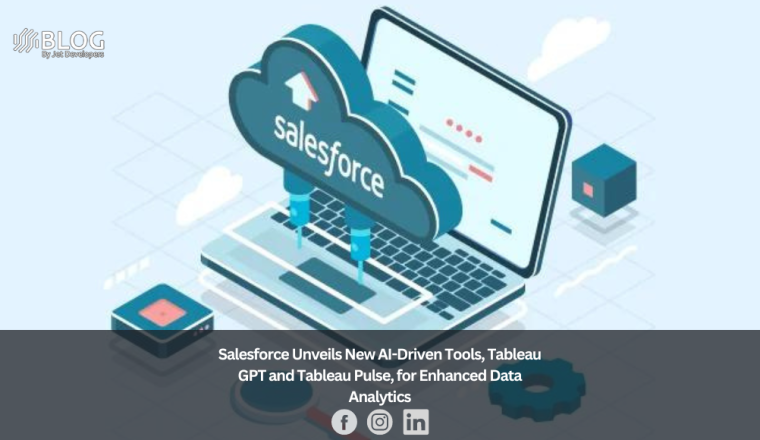
Salesforce Unveils New AI-Driven Tools, Tableau GPT and Tableau Pulse, for Enhanced Data Analytics

Salesforce has recently made an exciting announcement regarding the launch of two cutting-edge tools, Tableau GPT and Tableau Pulse, aimed at revolutionizing AI-assisted data analytics. These innovative tools harness the power of generative AI to deliver an enhanced data analysis experience, providing Tableau users with automatic data analysis and personalized analytics capabilities.

The introduction of Tableau GPT and Tableau Pulse is set to reshape how Tableau users interact with and analyze their data, significantly boosting efficiency and accuracy in the field of data analytics.

Tableau GPT is specifically designed to simplify access to AI-powered analytics, enabling employees to make well-informed decisions rapidly and effectively. By leveraging this tool, users can effortlessly generate visualizations and gain valuable insights by conversing with Tableau GPT within the console. Furthermore, Tableau GPT actively offers suggestions for new charts, visualizations, and questions based on user interactions.

Complementing Tableau GPT, Tableau Pulse provides business users and data consumers with a personalized analytics experience. Leveraging the automated insights generated by Tableau GPT, Tableau Pulse equips users with tailored metrics that are both easily understandable and actionable. These personalized metrics empower users to uncover new opportunities, anticipate and address issues proactively, and ultimately make better-informed decisions.

Salesforce emphasizes that the integration of Tableau’s composable analytics and Salesforce Data Cloud capabilities will unify customer data, facilitating the delivery of swift insights at scale. By harnessing the power of generative AI in analytics and leveraging real-time data from the Data Cloud, Tableau aims to empower individuals at all levels to make data-driven decisions with ease.

In addition to the aforementioned tools, Salesforce has also introduced the VizQL Data Service, a valuable resource that enables users to seamlessly embed Tableau into automated business workflows. Equipped with a user-friendly programming interface, developers can now effortlessly construct composable data products, eliminating the complexities associated with query construction and data modeling.

With the launch of Tableau GPT, Tableau Pulse, and the VizQL Data Service, Salesforce is driving innovation in the realm of data analytics, empowering organizations and individuals alike to unlock the full potential of their data and make data-driven decisions effortlessly. These advancements mark a significant leap forward in the field and herald a new era of AI-assisted data analytics.

Empowering data analytics through generative AI

Using Salesforce’s Einstein GPT on the backend, Tableau GPT and empowers users to surface new insights conversationally by asking questions within the console. The new tools also provide visual and easily digestible data analysis, enabling users to identify appropriate actions for their data.

For instance, if a user notices a metric is off-track, Tableau GPT will analyze and present the data visually, providing the user with insights so they can take appropriate action.

For its part, Tableau Pulse provides users with an AI-powered personalized experience, transforming how they work with data.

For example, it alerts users when a CSAT score decreases unusually; identifies potential causes, such as high levels of active tickets and longer response times; and delivers relevant and timely insights to keep users informed of their business’s performance.

Users can also collaborate and act on these insights directly within their usual workflow using collaboration tools like Slack and email.

“Tableau Pulse couldn’t exist without Tableau GPT, and classic Tableau workflows are streamlined or enhanced with Tableau GPT,” the spokesperson told VentureBeat. “Tableau Pulse uses Tableau GPT to provide automated analytics based on personalized metrics that are easy to understand and act on. It surfaces insights in both natural language and visual format so users get the information they need in a digestible way. And, with tight integrations with collaboration tools like Slack and email, users can share insights directly with colleagues within their workflow.”

Tableau GPT assists analysts by facilitating natural language calculations, recommending appropriate charts and visualizations, and automatically generating descriptions of data sources. For business users, Tableau GPT provides natural insights in plain language and even proactively presents the questions that the user might ask next.

Additionally, Tableau Pulse will act as a personalized guide for users’ data, understanding their data and the results they hope to achieve. As a result, it can deliver targeted and customized insights that are meaningful to the user.

“Since it’s powered by generative AI, you can talk to the new tools [as if there were] an advisor sitting in front of you. As a result, Tableau Pulse makes data friendly and easy for everyone, even non-technical users, and allows them to bring more value to their organization because they’re making smarter decisions,” said the Tableau spokesperson.

The company asserts that this marks the first Salesforce/Tableau application created from the ground up for generative AI. The new tools exceed the typical “natural language to query” or “natural language to viz” capabilities, harnessing the full potential of large language models.

“These surface as insight summaries, conversational experiences, and assisted curation (metric bootstrapping) and will progress to an agentic model in the near future. Our analytics agent will be able to semi-autonomously reason, dig for insights, come to conclusions, make recommendations and take action with human validation and input,” the spokesperson added.

The company clarified to VentureBeat that its Data Cloud offering will enable the unification of a company’s data from all channels and interactions into single, real-time customer profiles. In addition, when paired with Tableau, customer data can be visualized, making it easier for users to explore and derive insights.

Data Cloud’s zero-copy data-sharing feature allows users to virtually access Data Cloud data from other databases, providing instant accessibility. With “instant analytics,” a new capability within Data Cloud for Tableau, users can analyze and visualize Data Cloud data live inside Tableau. Additionally, they can query millions of records with one click.

“We’ll soon be announcing Data Cloud for Tableau, which brings a complete view of all your customer data to your entire organization so everyone can get insights at their fingertips and see a single view of their customers across every touchpoint,” the company spokesperson said. “These AI-powered insights let users take action right in the flow of their work — no jumping applications, opening new tabs or starting new programs.”

Enhanced automation for business workflows 

Tableau also introduced a new developer capability called VizQL Data Service, which enables users to seamlessly embed Tableau into an automated business workflow.

According to the company, this capability acts as a layer that sits on top of published data sources and existing models and allows developers to create composable data products through a simple programming interface. This feature streamlines and simplifies query construction and data modeling. Developers can also access Tableau’s analytical engine through this capability.

“[The] simple programming interface [of VizQL Data Service] allows developers to build new data products without needing the help of a data expert,” said the spokesperson. “For example, let’s say you want to build a new UI for some of the interactions and insights in Tableau. Or you want to integrate insights from Tableau into an automated business workflow. Or maybe you want to create a chatbot that interacts with your analytics in Tableau. Developers can do all of this with VizQL Data Services. And they can leverage Tableau’s data experiences to support people everywhere decisions are made.”

What’s next for Tableau? 

The company spokesperson told VentureBeat that it has ambitious plans for AI-driven innovation in the long run, and users should anticipate more comparable innovations in the near future that empower data-driven decision-making.

“We’re all just starting to become familiar with and understand the potential of generative AI, but we’re already seeing glimpses of how it may alter the world around us, specifically the world of analytics,” said the spokesperson. “Whatever the outcome, we know that a revolutionary shift in roles humans play across every industry is on the horizon.”

Alphabet to Unveil AI Advancements at Its Google I/O Event, Bard Could Get Bigger

Alphabet Inc. the parent company of Google, is gearing up to make a significant splash in the field of artificial intelligence (AI) at the highly anticipated Google I/O conference commencing on May 10. With AI being a prominent topic, Alphabet finds itself in a position where discussing AI is imperative. Simultaneously, the company faces the pressure to demonstrate its leadership in the domain, lest it relinquishes control to the formidable OpenAI-Microsoft partnership.

Following the remarkable success of ChatGPT, Microsoft solidified its collaboration with OpenAI through a substantial multi-year, multi-billion-dollar investment. Microsoft has been actively integrating AI into its extensive range of products, showcasing its determination to excel in the AI landscape.

In contrast, Alphabet has been perceived as lagging behind, encountering some challenges with the launch of its Bard AI and struggling with a sluggish rollout. However, the upcoming event presents an opportunity for Alphabet to reverse this narrative as it prepares to unveil numerous AI updates.

By showcasing its latest advancements at the conference, Alphabet aims to demonstrate its commitment to AI innovation and reclaim its position as a prominent player in the industry. The company seeks to impress attendees and industry observers alike with its refreshed AI offerings and showcase its ability to compete in the ever-evolving AI landscape.

As the conference unfolds, all eyes will be on Alphabet as it strives to make significant strides in AI and reclaim its foothold in the face of rising competition from the OpenAI-Microsoft collaboration.

What to expect at Google I/O?

According to CNBC, Alphabet is expected to focus on AI and how its products “help people reach their full potential.” According to the documents seen by the media company, Google will demonstrate “generative experiences” to Bard and Search operations using AI.

This will likely include using Bard to demonstrate its utility in coding, math, and logic, showing that the AI is at par with its OpenAI counterpart. However, the CNBC report said that Google would also showcase the AI’s expertise in following prompts in Korean and Japanese.

The expertise in multiple languages comes from its general-use large language model, PaLM, an improved iteration that will be unveiled at the event. PaLM2 supports more than 100 languages.

In March this year, the company also launched an experimental tool, a much more powerful version of Bard. Internally, Google has been working on a “multi-modal Bard” which uses a larger data set and also tested versions dubbed “Big Bard” and “Giant Bard”.

Much like Microsoft, Google is also expected to improve user experiences after incorporating AI into its products like Sheets, Slides, and Meet, which it began rolling out to limited sets of users starting March this year.

Google is also expected to update users on image recognition in Google Lens and allow users to search using camera and voice.

Spotify Removes Thousands of AI-Generated Songs Amidst Stream Manipulation Concerns

According to the Financial Times, Spotify has eliminated tens of thousands of songs created by the AI startup Boomy from its platform. Boomy offers users the ability to generate tunes in various styles, ranging from rap to lo-fi, and release them on streaming services to earn royalties.

Despite its public launch in 2021, Boomy claims on its website to have generated a staggering 14.5 million songs, accounting for approximately 14% of the world’s recorded music. However, Spotify removed these tracks due to artificially inflated streaming numbers, indicating potential stream manipulation.

Universal Music, a major player in the music industry, alerted various streaming platforms about suspicious activity surrounding Boomy’s songs, suggesting the involvement of bots to boost audience statistics. Subsequently, Spotify took down around 7% of the tracks uploaded by Boomy in response to Universal Music’s warning, as reported by the Financial Times.

In a statement provided to Insider, Spotify acknowledged that artificial streaming is an industry-wide problem and affirmed its commitment to combating it on their platform. The streaming giant stated that when cases of stream manipulation are identified or reported, appropriate actions are taken, including the removal of streaming numbers and the withholding of royalties. Spotify aims to protect honest and hardworking artists while maintaining fair royalty payouts.

The Financial Times had previously reported that Universal Music instructed streaming platforms to block AI services from training on its songs. The concern arises from AI’s ability to compose songs imitating the styles of different artists, potentially infringing on their intellectual property rights. A source close to the situation described how AI could be trained to create songs with Taylor Swift-like lyrics, Bruno Mars-like vocals, and a Harry Styles-inspired theme, leading to outputs derived from the intellectual property of these artists.

AI-generated songs using the voices of Drake and The Weeknd racked up millions of views on TikTok last month, before being taken down for copyright infringements, The Guardian reported.

Apple Co-founder Steve Wozniak Warns of AI-Enabled Scams and Calls for Greater Regulation

Steve Wozniak, the co-founder of Apple, has expressed concerns about the potential for artificial intelligence (AI) to facilitate convincing scams, according to a report by the BBC. In an interview with the BBC’s technology editor Zoe Kleinman, Wozniak discussed the need for increased regulation in the AI industry and highlighted the risks associated with advanced AI tools like OpenAI’s ChatGPT, which can generate highly intelligent-sounding text.

Wozniak emphasized that AI’s intelligence makes it susceptible to misuse by “bad actors” who aim to deceive individuals about their true identities. He stressed the importance of human accountability for content generated by AI, stating that individuals should take responsibility for anything AI produces and subsequently shares in the public domain.

The Silicon Valley veteran, who left Apple in 1985 but remained associated with the company until recently, expressed criticism of major tech firms and their role in AI development. He suggested that these companies may believe they can evade consequences for their actions.

Apple has not yet responded to requests for comment on Wozniak’s remarks concerning AI.

In March, Wozniak joined Elon Musk, Evan Sharp (co-founder of Pinterest), and other experts in signing an open letter calling for a six-month pause in the development of AI technology more advanced than OpenAI’s GPT-4. The letter raised concerns about the rapid and potentially uncontrolled deployment of AI tools that could pose risks to humanity’s future.

While Wozniak acknowledged the difficulty of halting the production of AI technology, he emphasized the need for better consumer awareness. By being well-informed about AI capabilities, individuals can better identify and protect themselves against malicious scams.

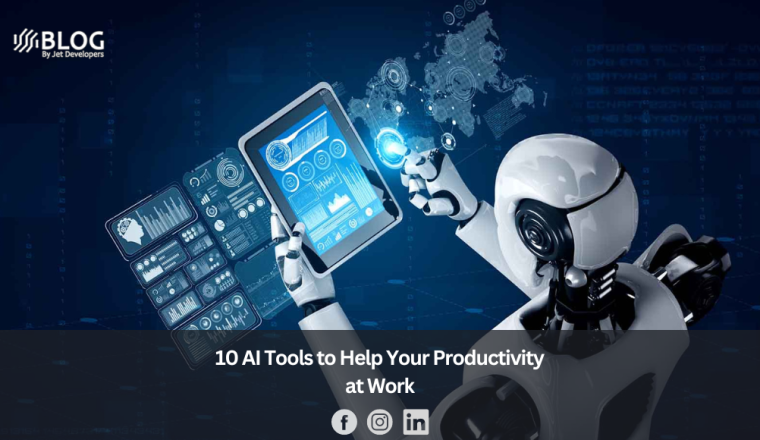
10 AI Tools to Help Your Productivity at Work

In today’s fast-paced work environment, harnessing the power of artificial intelligence (AI) tools can significantly boost productivity. Here are 10 AI tools that can revolutionize your workflow.

Fireflies: Taking notes

If you find yourself getting distracted in meetings because you’re multi-tasking by jotting down notes, there are plenty of AI-powered note-takers that may be able to help. One such tool is Fireflies AI.

You can invite it to meetings or set it up to automatically join calls on your calendar. This Google Chrome extension works with conferencing platforms like Zoom, Google Meet, and Webex, to record meetings and and transcribe them within minutes. You can then search your transcript to find action items, tasks, and questions; your colleagues can interact with the transcript using comments, pins, and reactions, and meetings notes can be shared to apps like Asana, Slack, and Notion.

Fireflies can also analyze the speech in your meetings to show metrics like how long someone spoke or how many questions they asked.

Remail: Writing emails

No matter your profession or industry, email probably makes up some part of your job.

Managing your inbox can be a pretty tedious time-suck, but tools like Remail might help you get through emails more efficiently.

With this Google extension for Gmail, you specify if you want to send a positive or negative response to an email, and it’ll draft a message for you in the style and tone of the conversation. You can also customize a response by summarizing what you want to say in a few words, and Remail will generate a full response based on your input.

Whatever you ask for, you’ll get multiple draft options to choose from. Remail’s website says its clients include employees from companies like Meta, Google, and Netflix.

Wordtune Read: Summarize text

Reading through lengthy reports can eat up a lot of time. AI readers like Wordtune Read might be able to help you get to the gist faster.

Using this Google Chrome extension, you can upload a PDF or paste a URL, and it’ll highlight the most relevant information from the text and give you brief summaries next to each passage.

It works for academic articles, business reports, blog posts, and more.

Tome: Building slide decks

If you make a lot of PowerPoints for work, the app Tome can help you do it faster.

It can turn documents into slide decks in seconds, with options to spruce up your presentations by adding 3-D renderings, live content, or even video narrations of your slides.

Numerous.ai: Create spreadsheets

If you work with large data sets in the course of your job, you might have a love-hate relationship with spreadsheets. In that case, a tool like Numerous.ai, which works with Google Sheets and Microsoft Excel, might be able to help.

Numerous.ai can quickly extract relevant information from large data sets, and sort and categorize items.

You can describe in your own words what you’d like a formula to accomplish, and Numerous.ai will generate a formula for your spreadsheet. You can also teach it to handle repetitive tasks like cell formatting or certain calculations.

Brain.fm: Staying focused

Focusing on tasks can be tough, especially if you work from home. Brain.fm, an AI-generated music tool, can help users stay on task. 

The browser-based web app is designed “to help listeners focus, relax and sleep,” according to the company.

The tool offers a range of music options — from atmospheric to electronic — that are designed by a team of scientists and composers to help users enter a state of “deep work,” or uninterrupted focus.

Grammarly: Boosting writing quality 

Jobs across all industries can require some form of writing. Grammarly, an AI-writing assistant, can help workers catch mistakes in their copy. 

Used by more than 30 million people and 50,000 teams globally, the browser extension makes suggestions about word choice and sentence structure, checks for plagiarism, generates citations, and reviews essays. It can also assess the tone of your writing. That way, e-mails, press releases, and internal memos can be written with a second pair of eyes. 

“It’s great at automatically catching errors and typos,” Deb Lee, a consultant who works with entrepreneurs and small business owners to boost their productivity.

ContactOut: Searching for contact information 

Finding contact information for prospective clients may be time consuming. ContactOut can reduce the amount of time spent doing just that. 

The Google Chrome browser extension — used by 1.4 million people — scrapes the internet to find active e-mails and phone numbers for professionals on Linkedin Standard, Sales Navigator, and Recruiter. It can also create a list of contacts and make a personalized email campaign out of it. The combination of these features can accelerate the process of landing new customers. 

Meanwhile, ContactOut can integrate with customer relationship management software like Salesforce and Hubspot.

Recruiters and sales representatives at Fortune 500 companies like Microsoft, Google, and PwC use the tool, according to the company

Todoist: Making to-do lists 

Writing to-do lists using pen and paper may not be for tech-savvy workers. Todoist, a plug-in tool, could provide a better alternative. 

The Google Chrome browser extension is used by more than 800,000 users to plan their days and complete tasks. Users can add different websites to their task list — like a blog post to finish reading, or an item you want on your wish list. That way, users can add or finish tasks in a single place, which can eliminate disruptions to their workflow when switching between platforms.

Todoist’s desktop and mobile app includes additional features, such as collaborative to-do lists, progress tracking, and reminder notifications. It can be integrated into more than 60 desktop and mobile apps including Google Drive, Slack, and Dropbox. 

BlockSite: Blocking websites to eliminate distractions 

Workers may be tempted to scroll through social media or read news articles during work hours. If that applies to you, the BlockSite plug-in could be a potential solution. 

Downloaded by over 1 million users, BlockSite is a Google Chrome extension workers can use to block distracting sites for a select period of time. That way, users can stay focused on their pressing tasks. 

Those tempted to find workarounds can lock the sites with a password to make them harder to access. 

The browser extension also includes focus mode, a feature that allocates a certain amount of time to a particular task, as well as data insights that show how much time a user spends on a website. 

Italian Startup Combines AI and Robotic Arm to Create Sculptures with Precision

A pioneering startup named Robotor is poised to transform the art of sculpting by streamlining the process through the integration of robotics and artificial intelligence. Founded by Filippo Tincolini and Giacomo Massari, the company aims to enhance the speed, efficiency, and sustainability of sculptural production.

According to a recent report by TNW, this groundbreaking technology enables the realization of intricate structures that were once considered unimaginable. Despite being a relatively young company, having commenced operations in 2004 under the name Torart, Robotor has already collaborated with renowned artists like Barry X Ball and played a pivotal role in recreating a replica of the Arch of Palmyra after its destruction by ISIS in 2015.

“Our robots are born from sculptors for sculpture,” stated Massari to TNW. “They emerge from the expertise of individuals deeply familiar with traditional sculpture, in a region like Carrara, which is the birthplace of sculpture itself.”

The underlying concept driving their innovation is to delegate labor-intensive tasks to robots. Massari further explained, “The entire Robotor project stems from a well-defined philosophy that originates from 18 years of experience in stone processing.”

With their cutting-edge technology and deep-rooted knowledge in the field, Robotor is poised to revolutionize the art of sculpting, introducing a new era where AI-guided robotic arms serve as valuable tools for artists and redefine the boundaries of creative expression.

How does it work?

Robotor uses a mechanical arm to create the sculptures. This robotic device uses electro-spindles of various sizes and capacities and boasts an automatic tool change function to adapt to a variety of structures.

A uniquely efficient software

But the machine could not function without Robotor’s proprietary software, called OR-OS. This software can either be programmed by expert operators or work fully autonomously.

OR-OS boasts the unique ability of taking a 3D model and automatically generating an optimized workflow and tool paths without the need for any human intervention. It then communicates with the robotic chisel that proceeds to construct the final sculpture.

The software tackles every step of the creation of a new structure from sculpting, to polishing and even cleaning. It expertly highlights the best and most sustainable paths to developing any figure.

Now, its founders hope it will usher in a new era for sculptures.

“The history of art is a continuous history of innovations,” told TNW Massari. “Artists have always relied on technological knowledge and ingenuity to find the materials and tools they need to express their dreams, thoughts, visions, or beliefs. And innovation has always had an impact on the way art is made.”