WordPress Ad Banner

Top 5 Ways GPT-4 Can Increase Workers Productivity

The language model that powers chatGPT, GPT-4, has developed the latest version with considerable improvements over GPT 3 and GPT 3.5. Though, workers can use GPT-4 to enhance their productivity and quality of work.

The newest version of GPT is capable enough to accept inputs in both the forms of text and images. In contrast, GPT 3 and 3.5 could only take data in text.

ChatGPT is an innovative artificial intelligence technology created by OpenAI. The company aims to provide effective results in less period.

However, I can suggest some potential ways in which a language model like GPT-4 could increase workers’ productivity in the future based on the advancements made by previous models like GPT-3:

  1. Automating Repetitive Tasks: GPT-4 could be used to automate repetitive tasks such as data entry, email responses, and social media posts, freeing up workers’ time to focus on more complex tasks.
  2. Enhancing Communication: GPT-4 could help workers communicate more efficiently by providing real-time language translation and automatic summarization of long texts or meetings, making it easier to understand and respond to information.
  3. Improving Research: GPT-4 could assist workers in conducting research by providing accurate and relevant information from a vast range of sources, making it easier to find the data needed to complete tasks.
  4. Streamlining Workflows: GPT-4 could help workers streamline their workflows by providing suggestions on the best way to complete a task, identifying potential roadblocks, and offering solutions to overcome them.
  5. Personalizing Work: GPT-4 could help workers personalize their work by analyzing their work habits, preferences, and productivity patterns and offering customized recommendations on how to improve their workflow and increase productivity.

Top 10 Productive Use Cases of ChatGPT for the Year 2023

ChatGPT is an OpenAI system developed by the company called OpenAI to improve the conventional capabilities of AI systems. The ChatGPT was specifically developed for the use of digital assistants and chatbots. Compared to other chatbots ChatGPT can be able to pick what has already been said in the conversation and it corrects itself if it makes any mistake. In this article, we have explained the top ten productive use cases of ChatGPT for the year 2023. Read to know more about ChatGPt Use Cases for 2023.

  1. It Answers Questions

Unlike any other chatbot, ChatGPT can answer questions in a classy way. And ChatGPT is capable of explaining complex issues in different ways or tonalities of speaking.

  1. It Develops APPS

Some users on Twitter asked ChatGPT for help in creating an app, and guess what! it actually worked. The AI tool even gave an example of code that can be used for a particular scenario. And in addition to that, it also gives general tips for App development; nevertheless, it must not be adopted without any personal correction or review.

  1. It Acts as An Alternative to Google Search

ChatGPT is not just a competitor of other chatbots but it has the potential to replace google search. This is because it has smart answers to the queries that users search for answers to. But the only drawback is that it cannot give the source references.

  1. It Can Compose Emails

ChatGPT can compose emails. Some Twitter users asked ChatGPT to compose readymade emails which received composed emails as a result. This probably puts an end to the blank page’s era.  

  1. It Creates Recipes

Depending on the request received, ChatGPT can also show suggestions on the recipes for cooking. Unfortunately, at this point, we cannot judge to what extent these are successful. But it would be interesting to try the resulting recipes for yourself.   

  1. Writing Funny Dialogue

ChatGPT also convinces users with its artistic skills. Some users had fun with the funny dialogues that the AI chatbot generated. It also writes skits and the results are impressive and great fun to read.

  1. Language Modeling

ChatGPT can be used to train other models, such as named entity recognition and part-of-speech tagging. This can be beneficial for businesses that require the extraction of meaning from text data.

  1. Converts Text to Speech

ChatGPT can convert text to speech, allowing it to be used in a wide range of applications such as voice assistants, automated customer service, and more.

  1. Text Classification

ChatGPT can be used to categorise text, such as spam or not spam, or positive or negative sentiment. Businesses that need to filter or organise large amounts of text data may find this useful. Apart from that, ChatGPT can also translate text from one language to another using. This can be useful for businesses that need to communicate in multiple languages with customers or partners.

  1. Sentiment Analysis

ChatGPT can analyze text sentiment to determine whether it is positive, negative, or neutral. Businesses that need to monitor customer sentiment or social media mentions may find this useful. Apart from that the ChatGPT also be used to summarize lengthy texts, making them easier to understand and digest. This applies to news articles, legal documents, and other types of content.

Privacy Alert: ChatGPT Exposes Private Conversations

OpenAI CEO expresses regret, claims error has been fixed.

Artificial Intelligence (AI) is transforming our lives and work, but recent developments have raised concerns about the privacy and security of user data when using AI-powered tools.

One of these concerns is the ChatGPT glitch that allowed some users to see the titles of other users’ conversations.

ChatGPT glitch

ChatGPT is an AI chatbot developed by OpenAI that allows users to draft messages, write songs, and code. Each conversation is stored in the user’s chat history bar.

However, users began seeing conversations they didn’t have with the chatbot in their chat history as early as Monday. Users shared these on social media sites, including Reddit and Twitter.

Company Response

OpenAI CEO Sam Altman expressed regret and confirmed that the “significant” error had been fixed. The company also briefly disabled the chatbot to address the issue. OpenAI claims that users couldn’t access the actual chats. Despite this, many users are still worried about their privacy on the platform.

Privacy Concerns

The glitch suggests that OpenAI has access to user chats, which raises questions about how the company uses this information.

The company’s privacy policy states that user data, such as prompts and responses, may be used to continue training the model.

However, that data is only used after personally identifiable information has been removed. Users fear that their private information could be released through the tool.

AI Tools and Privacy

The ChatGPT glitch comes as Google and Microsoft compete for control of the burgeoning market for AI tools. Concerns have been raised that missteps like these could be harmful or have unintended consequences.

There needs to be a greater focus on privacy and security concerns as AI becomes more prevalent in our lives. Companies must be transparent about how they collect, store, and use user data and must work quickly to address any issues.

Google Begins ChatGPT Rival “Bard” Testing to Limited Users

Google Begins ChatGPT Rival Bard Testing to Limited Users

Users can join a waitlist to gain access to Bard, which promises to help users outline and write essay drafts, plan a friend’s baby shower, and get lunch ideas based on what’s in the fridge.

A company representative told CNN it will be a separate, complementary experience to Google Search, and users can also visit Search to check its responses or sources. Google said in a blog post it plans to “thoughtfully” add large language models to search “in a deeper way” at a later time.

Google said it will start rolling out the tool in the United States and United Kingdom, and plans to expand it to more countries and languages in the future.

The news comes as Google, Microsoft, Facebook and other tech companies race to develop and deploy AI-powered tools in the wake of the recent, viral success of ChatGPT. Last week, Google announced it is also bringing AI to its productivity tools, including Gmail, Sheets and Docs. Shortly after, Microsoft announced a similar AI upgrade to its productivity tools.

Google unveiled Bard last month in a demo that was later called out for providing an inaccurate response to a question about a telescope. Shares of Google’s parent company Alphabet fell 7.7% that day, wiping $100 billion off its market value.

Like ChatGPT, which was released publicly in late November by AI research company OpenAI, Bard is built on a large language model. These models are trained on vast troves of data online in order to generate compelling responses to user prompts. The immense attention on ChatGPT reportedly prompted Google’s management to declare a “code red” situation for its search business.

But Bard’s blunder highlighted the challenge Google and other companies face with integrating the technology into their core products. Large language models can present a handful of issues, such as perpetuating biases, being factually incorrect and responding in an aggressive manner.

Google acknowledged in the blog post Tuesday that AI tools are “not without their faults.” The company said it continues to use human feedback to improve its systems and add new “guardrails, like capping the number of exchanges in a dialogue, to try to keep interactions helpful and on topic.”

Last week, OpenAI released GPT-4, the next-generation version of the technology that powers ChatGPT and Microsoft’s new Bing browser, with similar safeguards. In the first day after it was unveiled, GPT-4 stunned many users in early tests and a company demo with its ability to draft lawsuits, pass standardized exams and build a working website from a hand-drawn sketch.

Meta is still trying to make its virtual world a place where people want to spend time.

Meta’s Horizon Worlds is still floundering, but the company is trying a new hook to lure users: Missions.

The company on Tuesday released an update on the virtual world, introducing “quests” users can undertake to earn in-game rewards for their avatars, such as new outfits.

“We will continue to roll out this feature in the coming weeks and more people will have access to check it out in Giant Mini Paddle Golf, a new Horizon world where players play mini-golf across a tropical island landscape,” the company wrote.

At launch, players of the minigame will have six quests they can complete. The option to take part in these is currently limited, but Meta says it hopes to roll out the option to a larger audience in the weeks and months to come.

More mini-games are on the way to Horizon Worlds, which could mean more quest options. The company has said it plans to release 20 new “experiences” in the virtual world that are built by third-party studios in the near future.

Meta has continued to sink money into its metaverse initiative, but people who have spent time in Horizons haven’t stuck around, including Meta employees. And the founder of Oculus, who sold his VR startup to Meta in 2014 has lambasted Horizons, saying “I don’t think it’s a good product”.

Horizons saw a peak of about 200,000 active users in late December. Meta’s hoping to hit 500,000 by the end of June. As part of that effort, the company has reportedly considered lowering the age requirement from 18 to 13. Government officials have warned the company against doing that, citing the company’s “documented track record of failure to protect children and teens”.

10 Use Cases Of ChatGPT In Banking Sector

Here we are bringing the top 10 use cases of ChatGPT in the banking sector.

Client Assistance

ChatGPT facilitates the banking sector by providing support to their client care. It responds quickly and effectively to customer inquiries, complaints, and requests for information. In addition, the Banking sector feels blessed after having the capabilities of chatGPT.

Detection Of Fraud

ChatGPT is very helpful in detecting any kind of fraud. It analyzed a large amount of transaction data and identify suspicious patterns.

Hence, ChatGPT plays a vital role in assisting banks in safeguarding the financial assets of their customers and minimizing fraud losses. Technical departments at banks might set up alarms, therefore, security experts will be aware of dubious actions.

Credit Banking

The collection, evaluation, of data and the evaluation of risks, and the processing of loans are one of the most complex processes of bank operations.

However, Banks can easily cut down the efforts by using chatGPT’s Natural Language Processing (NLP) model. However, banks can also utilize their Machine Learning capabilities to make the loan origination process easier and quicker.

ChatGPT provides real-time guidance and assistance to customers who are willing to apply for loans.

Therefore, Banks can take advantage of chatGPT to gather information about their customers, evaluate their creditworthiness, and offer real-time feedback on loan applications.

Banks can utilize the application in many ways to lessen the likelihood of default and by analyzing huge data.

Financial Management

ChatGPT can assist banks in providing personalized wealth management services to their customers. ChatGPT helps in analyzing customer data and providing customized investment recommendations. The best part is, it takes the decision on an individual basis.

Compliance

The banking sector heavily relies on consistency, and failing to do so can result in severe financial penalties and reputational damage.

Hence, by monitoring banking transactions and identifying potential violations of compliance, chatGPT can help banks in adhering the requirements of the regulatory bodies. The new innovation chatGPT can help banks in protecting their reputation and avoid costly penalties and fines.

AML And KYC

Banks need to know your customer (KYC) and Anti Money Laundering (AML) process to cut down the risks of financial dangers and stay in compliance with the law.

Therefore, by evaluating a large amount of customer personal information and transaction history, chatGPT can help banks in automating these processes.

Moreover, it can easily identify suspicious transactions, and verify the identity of customers.

Planning Your Finances

Many clients depend on banks to give them leverage in monetary arranging administrations and this can be easily done by chatGPT. The new advanced technology helps in providing a proper financial plan for their future. This includes budgeting, retirement planning, and budgeting.

Onboarding New Customers

ChatGPT help banks to develop strong relationship with their customers. Building strong relationships is time-consuming and needs powerful strategies. By using chatGPT, banks can make the process smooth and easier.

Opening New Records

It can help banks accurately check customer data and identify problems that need to be done by verifying customer identities.

However, chatGPT can help banks identify and manage potential risks by analyzing massive amounts of data and locating potential risk factors.

In addition, banks can use chatGPT to monitor transactions, flag questionable ones, and identify potential fraud.

Additionally, by examining news and market data, the model can also assess potential economic risks that might have an impact on the bank’s operations.

By utilizing chatGPT’s machine learning capabilities, banks can gradually improve their risk management practices.

Banking Virtual Assistants

Banks can provide their customers with a 24/7 remote assistant to help them with dealing with their records, paying their bills, and competing transactions

Man Creates Remarkable 3D Game Using GPT-4

To create a basic Doom style game, the man asked users to simply ask GPT4 to create a game that resembles Doom

ChatGPT took the internet by storm upon its release last year. With the launch of GPT 4 a few days ago, AI experts are experimenting with the model and testing all the limits to which it can exceed.

While people had enough hopes for this new AI technology when it came to basic AI work, what no one expected from GPT 4 was to develop a full-fledged game. However, technology is the name for surpassing user expectations and that is exactly what has happened.

The Indian Express on Twitter spotted an AI enthusiast Jani Lopez who experimented with GPT4 and gave an in-depth breakdown to show how this latest technology could be used for game development purposes. In a twitter thread shared by the user, he demonstrated how to leverage the AI technology to produce basic video games similar to a well-known one like Doom, ways one should use the AI to generate the required codes, showed simple steps on how to increase the game’s prototype visual appeal and showed small glimpses of codes written entirely by the GPT4 itself.

Javi stated that while users can create some meaningful content, they should look at the AI realistically and keep their expectations in check before wanting the GPT version to pop out something never seen before.

In order to create a basic Doom style game, Jani said that users can simply ask GPT4 to create a game in resemblance to Doom. He further stated that while tis initial request might seem basic, users can improve the visual aesthetics and overall working of the game once they have the foundation established.

The fact that GPT4 can create something as complex as a game shows that this is only the tip of the iceberg. Users can easily expect GPT4 to bring forward even more astounding creations and take the world of technology by storm. Who knows what the next year in the tech world will bring, but what we know is that we will be here to keep you updated!

Gaming Company Makes AI Bot as CEO, Record-Breaking Rise in Stock Market

Artificial intelligence has been making its presence known across different industries for quite some time now. From autonomous cars to facial recognition technology, the possibilities of AI are limitless. Recently, a gaming company has taken a step forward in AI implementation, by making an AI bot its CEO. This decision has resulted in the gaming company’s stocks hitting a record-breaking high.

NetDragon Websoft has appointed an AI bot to be its new CEO.

A Hong Kong-based gaming company NetDragon Websoft, made a groundbreaking decision to appoint an AI bot as its CEO before the popular AI chatbot, ChatGPT, became well-known. The AI bot, named Tang Yu, was chosen to lead the NetDragon Websoft company, resulting in a significant boost in the company’s stock market performance, outperforming even the Hong Kong stock market. NetDragon Websoft explained that Tang Yu was tasked with spearheading the implementation of AI technology to revolutionize corporate management and enhance operational efficiency to unprecedented levels. This move demonstrated the potential for AI to replace humans in certain scenarios.

Tang Yu, the AI CEO of the gaming firm Net Dragon Websoft, was assigned normal duties for the organization that included reviewing the most advanced analytics, making management decisions taking risk assessments, and fostering a more efficient workplace. Tang Yu was the first CEO of a company who operated 24 hours a day without compensation . The company claimed when they appointed the AI chatbot as its CEO that it would be a key factor in the growth of talent and ensuring a wide and productive workplace for everyone.

Remarkably, the AI bot contributed to the company’s revenue generation. According to reports, NetDragon Websoft outperformed the Hang Seng Index, which monitors the largest Hong Kong-based companies.

According to The Hustle, a stock market performance tracker, NetDragon Websoft’s shares have risen by 10% compared to their value six months ago. This surge in value could be attributed to multiple factors, including heightened demand for the company’s products or services, better financial performance, or favorable news about the company. The company’s present market capitalization is around HK$9 billion, equivalent to $1.1 billion.

Dejian Liu, the Chairman of NetDragon, commented on the appointment of the AI CEO, stating that the company firmly believes that Artificial Intelligence (AI) is the future of corporate management. They are dedicated to leveraging AI to revolutionize their business operations, which is exemplified by the appointment of Ms. Tang Yu. The company intends to extend the algorithms supporting Tang Yu to establish a management model that is transparent, interactive, and open. Additionally, they plan to transition to a metaverse-based working community to attract a more diverse pool of talent worldwide and accomplish greater objectives.

What is artificial intelligence and what is it not?

  • Artificial intelligence (AI) is set to transform many aspects of day-to-day life.
  • There are, however, many misconceptions about AI and its potential uses.
  • “The exaggerations about AI’s potential largely stem from misunderstandings about what AI can actually do,” said Kay Firth-Butterfield, the Head of Artificial Intelligence and Machine Learning at the World Economic Forum.

Broadly speaking, artificial intelligence (AI) is a field of study and type of technology characterized by the development and use of machines that are capable of performing tasks that usually would have required human intelligence.

AI has already transformed many industries and aspects of society, ranging from the introduction of customer service chatbots to enhanced GPS and mapping applications. However, there are several misconceptions about AI and its potential uses.

In the following Q&A, Kay Firth-Butterfield, the Head of Artificial Intelligence and Machine Learning at the World Economic Forum, details the different types of AI, important developments and applications in the field of machine learning and—perhaps most importantly—discusses common misunderstandings about AI.

What are the different types of AI?

“AI consists of several different machine learning models. These include, but are not limited to, reinforcement learning, supervised and unsupervised learning, computer vision, natural language processing and deep learning.

“All of the machine learning models develop and advance statistical predictions, but differ in their use and comprehension of data. ChatGPT, for example, is an AI-powered chatbot that is able to predict the most likely next word in a sentence. With numerous and relatively accurate predictions, ChatGPT is able to create coherent paragraphs.”

What do most people misunderstand about Artificial Intelligence (AI)?

“AI is not intelligence—it is prediction. With large language models, we’ve seen an increase in the machine’s ability to accurately predict and execute a desired outcome. But it would be a mistake to equate this to human intelligence.

“This is clear when examining machine learning systems that, for the most part, can still only do one task very well at a time. This is not common sense and is not equivalent to human levels of thinking that can facilitate multi-tasking with ease. Humans can take information from one source and use it in many different ways. In other words, our intelligence is transferable—the ‘intelligence’ of machines is not.”

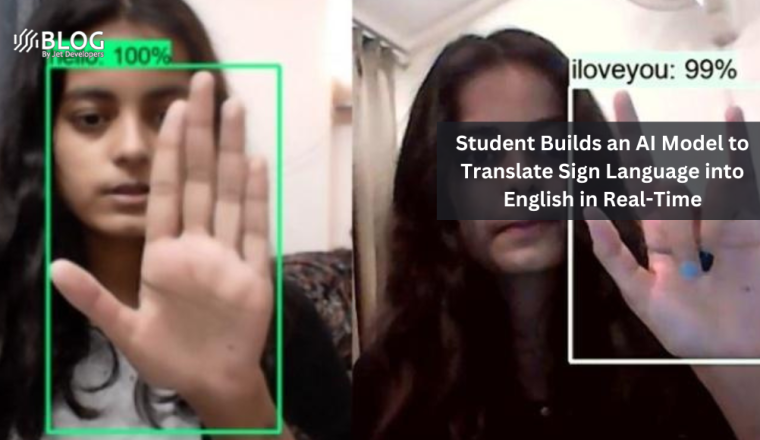
Student Builds an AI Model to Translate Sign Language into English in Real-Time

Artificial Intelligence (AI) has been used to develop various kinds of translation models to improve communication amongst users and break language barriers across regions. Companies like Google and Facebook use AI to develop advanced translation models for their services. Now, a third-year engineering student from India has created an AI model that can detect American Sign Language (ASL) and translate them into English in real-time.

Indian Student Develops AI-based ASL Detector

Priyanjali Gupta, a student at the Vellore Institute of Technology (VIT), shared a video on her LinkedIn profile, showcasing a demo of the AI-based ASL Detector in action. Although the AI model can detect and translate sign languages into English in real-time, it supports only a few words and phrases at the moment. These include Hello, Please, Thanks, I Love You, Yes, and No.

Gupta created the model by leveraging Tensorflow object detection API and using transfer learning through a pre-trained model called ssd_mobilenet. That means she was able to repurpose existing codes to fit her ASL Detector model. Moreover, it is worth mentioning that the AI model does not actually translate ASL to English. Instead, it identifies an object, in this case, the signs, and then determines how similar it is based on pre-programmed objects in its database.

In an interview with Interesting Engineering, Gupta noted that her biggest inspiration for creating such an AI model is her mother nagging her “to do something” after joining her engineering course in VIT. “She taunted me. But it made me contemplate what I could do with my knowledge and skillset. One fine day, amid conversations with Alexa, the idea of inclusive technology struck me. That triggered a set of plans,” she told the publication.

Gupta also credited YouTuber and data scientist Nicholas Renotte’s video from 2020, which details the development of an AI-based ASL Detector, in her statement.

Although Gupta’s post on LinkedIn garnered numerous positive responses and appreciation from the community, an AI-vision engineer pointed out that the transfer learning method used in her model is “trained by other experts” and it is the “easiest thing to do in AI.” Gupta acknowledged the statement and wrote that building “a deep learning model solely for sign detection is a really hard problem but not impossible.”

“Currently I’m just an amateur student but I am learning and I believe sooner or later our open-source community, which is much more experienced and learned than me, will find a solution and maybe we can have deep learning models solely for sign languages,” she further added.

You can check out Priyanjali’s GitHub page to know more about the AI model and access the relevant resources of the project. Also, let us know your thoughts about Gupta’s ASL Detector in the comments below.