WordPress Ad Banner

How Al And ChatGPT Will Actually Create More Jobs For Humans

Artificial intelligence is here, and it’s coming for your job. So promising are the tool’s capabilities that Microsoft — amid laying off 10,000 people — has announced a “multiyear, multibillion-dollar investment” in the revolutionary technology, which is growing smarter by the day. And the rise of machines leaves many well-paid workers vulnerable, experts warn.

“AI is replacing the white-collar workers. I don’t think anyone can stop that,” said Pengcheng Shi, an associate dean in the department of computing and information sciences at Rochester Institute of Technology. “This is not crying wolf,” Shi told The Post. “The wolf is at the door.”

From the financial sector to health care to publishing, a number of industries are vulnerable, Shi said. But as AI continues its mind-blowing advancements, he maintains that humans will learn how to harness the technology.

Artificial intelligence is already at a point where it can do the jobs people are paid for. AI is already having an impact on multiple industries, professors warn.

Already, AI is upending certain fields, particularly after the release of ChatGPT, a surprisingly intelligent chatbot released in November that’s free to the public.

Earlier this month, it emerged that consumer publication CNET had been using AI to generate stories since late last year — a practice put on pause after fierce backlash on social media. Academia was recently rocked by the news that ChatGPT had scored higher than many humans on an MBA exam administered at Penn’s elite Wharton School. After Darren Hick, a philosophy professor at South Carolina’s Furman University, caught a student cheating with the wildly popular tool, he told The Post that the discovery had left him feeling “abject terror” for what the future might entail.

Hick and many others are right to be worried, said Chinmay Hegde, a computer science and electrical engineering associate professor at New York University.

“Certain jobs in sectors such as journalism, higher education, graphic and software design — these are at risk of being supplemented by AI,” said Hegde, who calls ChatGPT in its current state “very, very good, but not perfect.”

For now, anyway.

Here’s a look at some of the jobs most vulnerable to the fast-learning, ever-evolving technology.

Education

Professors and teachers, in theory, could be replaced by AI courses, according to experts.
Professors and teachers could be replaced by AI courses, according to experts.

As it stands now, ChatGPT — currently banned in NYC schools — “can easily teach classes already,” Shi said. The tool would likely be most effective at the middle or high school level, he added, as those classes reinforce skills already established in elementary school.

“Although it has bugs and inaccuracies in terms of knowledge, this can be easily improved. Basically, you just need to train the ChatGPT,” Shi continued.

As for higher education, both Shi and Hegde maintain that college courses will need a human leader for the foreseeable future, but the NYU professor did admit that, in theory, AI could teach without oversight.

In the meantime, educators are seeing their roles transformed nearly overnight. It’s already become a struggle to adapt teaching and testing methods in efforts to keep up with the increasingly talented ChatGPT, which, according to Shi, can successfully complete a corner-cutting student’s coursework at a master’s level.

Doctoral candidates hoping for a shortcut are likely out of luck: Creating an independent thesis on an area not often or thoroughly studied is beyond AI’s abilities for the time being, he said.

Finance

AI like ChatGPT could take over spreadsheet style jobs in finance, experts warn.
AI like ChatGPT could take over spreadsheet-style jobs in finance, experts warn.

Wall Street could see many jobs axed in coming years, as bots like ChatGPT continue to better themselves, Shi told The Post.

“I definitely think [it will impact] the trading side, but even [at] an investment bank, people [are] hired out of college and spend two, three years to work like robots and do Excel modeling — you can get AI to do that,” he explained. “Much, much faster.”

Shi is certain, however, that crucial financial and economic decisions will likely always be left in human hands, even if the data sheets are not.

Software engineering

Relatively simple software design jobs are at risk from ChatGPT and other AI.
Relatively simple software design jobs are at risk.

Website designers and engineers responsible for comparatively simple coding are at risk of being made obsolete, Hegde warns.

“I worry for such people. Now I can just ask ChatGPT to generate a website for me — any type of person whose routine job would be doing this for me is no longer needed.”

In essence, AI can draft the code — hand-tailored to a user’s requests and parameters — to build sites and other pieces of IT.

Relatively uncomplicated software design jobs will be a thing of the past by 2026 or sooner, Shi said.

“As time goes on, probably today or the next three, five, 10 years, those software engineers, if their job is to know how to code … I don’t think they will be broadly needed,” Shi said.

Journalism

AI is already making it way into newsrooms.
AI is already making its way into newsrooms.

The technology is off to a rocky start in the news-gathering business: CNET’s recent attempts (and subsequent corrections to its computer-generated stories) were preceded by the Guardian, which had GPT software write a piece in 2020 — with mixed results.

Still, there is one job the technology is already highly qualified for, according to Hegde.

“Copy editing is certainly something it does an extremely good job at. Summarizing, making an article concise and things of that nature, it certainly does a really good job,” he said, noting that ChatGPT is excellent at designing its own headlines.

One major shortcoming — salvation for reporters and copy editors, at least for now — is the tool’s inability to fact-check efficiently, he added.

“You can ask it to provide an essay, to produce a story with citations, but more often than not, the citations are just made up,” Hegde continued. “That’s a known failure of ChatGPT and honestly we do not know how to fix that.”

Graphic design

Graphic design jobs also face potential obsoleting from AI.
Graphic design jobs also face potentially becoming obsolete thanks to AI.

In 2021, ChatGPT developer OpenAI launched another tool, DALL-E, which can generate tailored images from user-generated prompts on command. Along with doppelgangers such as Craiyon, Stable Diffusion, and Midjourney, the tool poses a threat to many in the graphic and creative design industries, according to Hegde.

“Before, you would ask a photographer or you would ask a graphic designer to make an image [for websites]. That’s something very, very plausibly automated by using technology similar to ChatGPT,” he continued.

Shi recently commanded DALL-E to make a cubist portrait of rabbits for the Lunar New Year, which he said came out “just amazing.” But, although it captured the hard-lined, Picasso-derived painting style, Shi noticed that it was not successful with more nuanced techniques — exposing a current shortcoming in the tech.

Al Images Showing Mark Zuckerberg Walking The Ramp Take Internet By Storm

Meta’s CEO, Mark Zuckerberg, is generally seen in a regular attire of t-shirts, jeans, and sneakers; it’s a little different to see him wearing a designer Louis Vuitton outfit and also walking on the ramp. But the artificial technology has made it possible, causing a lot of confusion among internet users because the images appear very real.

It would be challenging to distinguish the fake images produced by AI from real ones since they are so uncannily realistic. Zuckerberg can be seen maintaining the flawless expression that models frequently sport during the rampwalk.

It’s not the first time artificial intelligence (AI) images have swept the internet. Many of the expert artists who have employed this technology have produced sometimes unimaginable images.

Impact of ChatGPT and other generative AI technologies on the freelance economy.

The furore around ChatGPT and other innovations in generative AI — be it Google’s Bard or other new AI image tools — can be equally exciting for some and overwhelming for many others, particularly in the field of freelancing. Freelancers, who operate independently and offer their services to various clients, have found AI technologies to be a game-changer in their field. From content creation to customer support, AI-powered tools like ChatGPT have provided freelancers with the ability to automate and streamline their work processes, allowing them to focus on delivering high-quality work to their clients.

The impact of generative AI technologies like ChatGPT on the freelance economy cannot be overstated. One of the most significant benefits is the increased efficiency and productivity of freelancers. ChatGPT, for example, can generate high-quality content within minutes, which would otherwise take hours for a human writer to complete. This enables freelancers to take on more work, deliver results faster, and ultimately earn more income.

Another significant benefit of generative AI technologies like ChatGPT is that they provide freelancers with the ability to offer more diverse services to their clients. For example, a freelance writer who previously only offered content creation services can now offer additional services like social media management, chatbot creation, and customer support through the use of generative AI technologies. This increased service offering enables freelancers to diversify their income streams and become more competitive in their market.

The impact of generative AI like ChatGPT technologies on the freelance economy is not limited to increased efficiency and productivity or expanded service offerings. AI-powered tools like ChatGPT have also provided freelancers with the ability to offer more personalized services to their clients. Chatbots, for example, can be programmed to provide personalized responses to customer inquiries, which can lead to increased customer satisfaction and loyalty. This, in turn, can lead to repeat business for freelancers.

Another benefit of generative AI technologies like ChatGPT is that they have enabled freelancers to work remotely and communicate more effectively with clients from all over the world. AI-powered translation tools, for example, have made it easier for freelancers to communicate with clients who speak different languages. This has opened up new opportunities for freelancers to work with clients from all over the world, without the need for expensive travel or language learning.

Despite the many benefits of generative AI technologies like ChatGPT, there are also some potential downsides to consider. One concern is that the widespread adoption of AI-powered tools could lead to job displacement. As AI-powered tools become more sophisticated, they may be able to replace human workers in certain tasks, such as content creation or customer support. This could lead to a reduction in demand for certain types of freelancers, particularly those who offer services that can be automated.

Another concern is that the increasing use of AI-powered tools could lead to a homogenization of services. As more and more freelancers adopt AI-powered tools like ChatGPT, it could lead to a standardization of services, with clients choosing freelancers based on the quality of their AI tools rather than their unique skills and expertise. This could lead to a commoditization of freelancing, with freelancers competing solely on price rather than on their unique value propositions.

Despite these potential downsides, the overall impact of generative AI technologies like ChatGPT on the freelance economy is overwhelmingly positive. These tools have enabled freelancers to work more efficiently, offer more diverse services, and provide more personalized experiences to their clients. As AI-powered tools continue to evolve and become more sophisticated, it is likely that they will play an increasingly important role in the freelance economy. Freelancers who are able to embrace these technologies and incorporate them into their work processes are likely to be the most successful in the years to come.

No Tech Skills Required! Al Prompt Engineers Jobs Can Earn You Up To $335,000 A Year

Generative AI tools like ChatGPT have created a burgeoning market for “prompt engineers” who are responsible for improving the responses of AI chatbots. These high-paying jobs can offer salaries as high as $335,000 a year and often don’t require a degree in tech.

Anthropic, a leading AI safety and research company, is currently seeking a qualified “prompt engineer and librarian” to join their team. The position boasts an attractive salary range, spanning from $175,000 to $335,000. As a crucial member of the team, the selected individual will be responsible for curating an extensive library of top-tier prompts and prompt chains, while also developing interactive tools aimed at educating customers in the art of prompt engineering. Although some prior experience in programming and familiarity with large language models is preferred, Anthropic enthusiastically encourages all interested candidates to apply, even if they don’t meet every qualification.

The realm of prompt engineering is experiencing rapid growth, which is evidenced by Prompt Base’s recent launch of a prompt marketplace just last June. However, some cautious recruiters warn that most high-paying positions within this field typically require a strong background in technology and formal education. Despite this, it’s worth noting that many successful prompt engineers have emerged from non-tech backgrounds, finding immense satisfaction in the creative and analytical aspects of their work. The opportunity to craft engaging, thought-provoking prompts that steer AI systems towards optimal outcomes can be incredibly fulfilling.

Yet, as with any burgeoning field, uncertainties linger. Some experts wonder if prompt engineering will maintain its status as a highly sought-after profession in the long term, considering the rapid evolution of AI technology. The continuous advancements in the field might lead to shifts in job demands and priorities, prompting professionals to adapt and expand their skill sets accordingly.

In conclusion, the role of a prompt engineer and librarian at Anthropic presents an exciting opportunity for individuals passionate about AI safety and research. With the potential for substantial compensation and the chance to shape the future of AI through prompt engineering, interested candidates from diverse backgrounds are encouraged to apply and contribute their unique perspectives to this ever-evolving domain. While the future remains uncertain, the growth and significance of prompt engineering in shaping AI’s trajectory cannot be underestimated.

Indian Channel Introduce Al-Based News Anchor “AI-Sana” for Weather Report

Indian media organization “India Today” has introduced a female AI news anchor named “Sana,” following in the footsteps of Chinese artificial intelligence-powered news anchors. The move towards AI-driven bots is due to their proven effectiveness and ability to produce satisfactory outcomes with less labor. At the India Today Conference 2023, Kalli Purie, vice chairman of the India Today Group, introduced the Sana AI bot.

Purie described Sana as a “bright, gorgeous, ageless, tireless” robot who can “speak in multiple languages” and is “totally” under his control. The Sana feature of Aaj Tak AI will launch the following week and provide daily news updates in multiple languages numerous times per day. Additionally, Sana will host a new show where she explains a specific topic every day, interacts with the audience, and takes questions.

11-year-old girl develops app that detects eye diseases

The 11-year-old girl’s mobile app can analyse various parameters such as light and colour intensity to locate the eyes within the frame range

Meet Leena Rafaq an 11-year-old Dubai-based Malayali girl originally from Kerala, who has developed an AI application to detect eye diseases and other conditions through a unique scanning method using an iPhone. Rafaq named the application “Ogler EyeScan” and began developing it when she was 10. In a video, she said that her application can analyse various parameters like color and light intensity, distance and look-up points to locate eyes within the range of the frame using advanced computer and machine learning,

In her post, Leena added that “Exciting news! I am thrilled to announce the submission of my new Artificially Intelligent mobile app, named Ogler EyeScan,” Rafeeq said in a LinkedIn post on Saturday adding that she created the AI mobile app when she was 10, the application also identifies any light burst issues and if the eyes are positioned exactly inside the scanner frame. She also said “Olger” can identify conditions like Arcus, Malenoma, Pterygium and even Cataracts with help of trained models.

Leena said that her app is currently under review in Apple’s app store and is hopeful that it will be approved soon. The Olger EyeScan is only supported in iPhone 10 and above with iOS 16+. She also said, “This App was developed natively with SwiftUI without any third-party libraries or packages, and it took me six months of research and development to bring this innovative app to life.”

Reverting to some of the comments on her viral LinkedIn post, she mentioned that the accuracy of her app is “nearly 70% at this moment.”

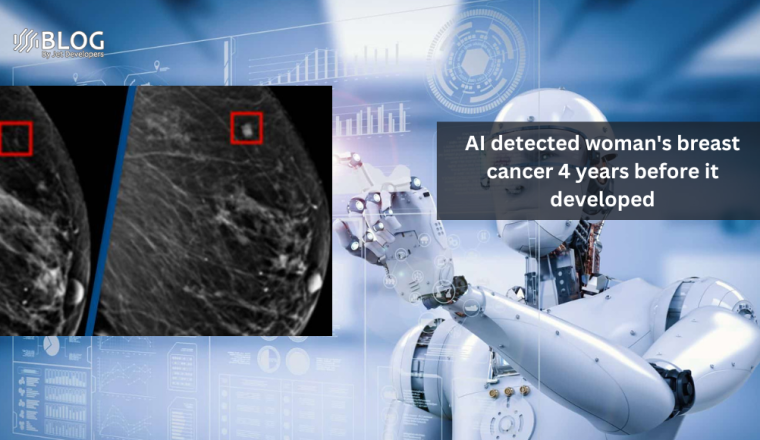
AI detected woman’s breast cancer 4 years before it developed

An AI program was successfully able to detect breast cancer in a woman four years before it developed.

While some developments of AI can sound pretty scary there are times when advancements in technology can do a great deal of good.

Certain forms of technology are being used to help diagnose conditions that impair a person’s mobility and there have been advances in the way we’re using Artificial Intelligence too.

AI is being used in cancer screening technology to pick up potential issues long before they develop into something harmful.

This technology is currently being used to great success in Hungary, while the US, UK and the rest of Europe are also looking at testing it for themselves.

While there are still many hurdles to get through, this technology could be a valuable tool for radiologists and ultimately be a lifesaver.

The image on the left shows something the AI identified as cancer, on the right is four years later as it started to develop. Credit: Lauder Breast Center at the Memorial Sloan Kettering Cancer Center/CNN

Speaking to CNN, Dr Larry Norton of the Lauder Breast Center explained that while the technology has been around for decades AI is becoming a useful tool in refining the process and helping identify potential health issues.

He said: “AI is a tool that machines use for looking at images and comparing those images to ones that have already been recorded in the machine to identify abnormalities.

“This technology can look at mammograms and identify areas that a human radiologist may want to look at more carefully.

“It’s called computer assisted detection, it’s actually been around since the late 1990s but the technology is improving.”

Dr Norton went on to explain how the technology worked, saying: “There’s lots of abnormalities that you see, they’re changes that are not really cancer. You can’t call everything cancer because anyone going for a mammogram is gonna need a biopsy. That’s not very practical.

“What this work does is it identifies risk. It can tell a woman ‘you’re at high risk of developing breast cancer’ before you develop breast cancer.”

However, he stressed that while AI had made some impressive advancements, this technology was in place to help human decision-makers rather than outright replace medical professionals.

“One thing humans can do that machines can’t do is order special tests. Things like contrast enhanced mammograms and MRIs,” Dr Norton said.

“The other thing humans can do is look at previous mammograms and see if there’s any changes.”

“We’ve got to think of AI as a tool for helping radiologists look at the images better. It’s not a standalone test, it’s not gonna replace a radiologist.”

According to the New York Times, the use of this AI technology in breast cancer screening has reduced the workload of a radiologist by around 30 percent while increasing cancer detection rates by 13 percent which sounds like entirely positive news.

They also report that the AI was tested with some of the most challenging cancer cases where the early signs of breast cancer had not been spotted by radiologists, with the AI successfully managing to identify the cancer.

Scientists Want To Use Real Human Brain Cells For Al

A team of scientists, led by Johns Hopkins University, has proposed the development of a biological computer that could surpass silicon-based machines in performance and energy efficiency. 

The computer will be powered by millions of human brain cells, arranged in arrays of brain organoids, which are small three-dimensional neural structures grown from human stem cells. The organoids will be connected to sensors and output devices, and trained using techniques such as machine learning and big data. 

The researchers have published a detailed roadmap in the journal Frontiers in Science, outlining their vision for what they call “organoid intelligence”. This ultra-efficient system aims to solve problems that are beyond the capabilities of conventional digital computers, while also supporting the development of neuroscience and medical research. 

Although similar to quantum computing in ambition, the project raises ethical concerns regarding the “consciousness” of brain organoid assemblies.

Generative AI set to affect 300mn jobs across major economies

The latest breakthroughs in artificial intelligence could lead to the automation of a quarter of work in the US and the eurozone, according to a study by Goldman Sachs.

The investment bank said Monday that “generative” AI systems like ChatGPT, which can create content indistinguishable from human performance, could spark a productivity boom that would eventually lift annual global gross domestic product by 7 percent over a 10-year period would increase period.

But if the technology lived up to its promise, it would also bring “significant disruption” to the labor market and expose the equivalent of 300 million full-time workers in major economies to automation, according to Joseph Briggs and Devesh Kodnani, the paper’s authors. Lawyers and administrative staff would be most at risk of being fired.

They calculate that about two-thirds of jobs in the US and Europe experience some level of AI automation, based on data on the tasks typically performed across thousands of jobs.

Most people would see less than half of their workload automated and likely continue their work, freeing up some of their time for more productive activities.

In the USA, this should apply to 63 percent of the workforce, they calculated. Another 30 percent who work physically or outdoors would not be affected, although their work could be vulnerable to other forms of automation.

But about 7 percent of US workers have jobs where at least half of their tasks could be done by generative AI and are vulnerable to replacement.

Goldman said his research pointed to a similar impact in Europe. With manual labor accounting for a larger share of employment in the developing world, around a fifth of the work globally could be done by AI — or about 300 million full-time jobs in major economies.

The report will ignite debate on the potential of AI technologies to both revive the rich world’s flagging productivity growth and create a new class of dispossessed white-collar workers who risk suffering a fate similar to that of manufacturing workers in the United States 1980s.

Goldman’s estimates of the impact are more conservative than some academic studies that considered the impact of a broader range of related technologies.

A paper published last week by OpenAI, the creators of GPT-4, found that 80 percent of the US workforce could see at least 10 percent of their jobs done by generative AI, based on analysis by human researchers and the company’s large machine language model ( LLM).

Europol, the law enforcement agency, also warned this week that rapid advances in generative AI could help online scammers and cybercriminals, so “dark LLMs . . . could become an important criminal business model of the future”.

Goldman said that if corporate investment in AI continued to grow at a similar pace to software investment in the 1990s, US investment alone could reach 1 percent of US GDP by 2030.

The Goldman estimates are based on an analysis of US and European data on the tasks typically performed in thousands of different jobs. Researchers hypothesized that AI would be able to perform tasks such as filling out tax returns for a small business; evaluation of a complex insurance claim; or document the results of a crime scene investigation.

They did not envisage AI being used for more sensitive tasks such as making a court decision, checking a patient’s status in intensive care, or studying international tax laws.

A Wharton Professor Gave AI Tools 30 Minutes To Work On A Business Project

Artificial intelligence is presenting new possibilities in terms of how to do work, and leaving many observers nervous about what will become of white-collar jobs.

Ethan Mollick, a management professor at the Wharton School of the University of Pennsylvania, has been closely following developments in generative A.I. tools, which can create essays, images, voices, code, and much else based on a user’s text prompts.

Ethan Mollick

He recently decided to see how much such tools could accomplish in only 30 minutes, and described the results this weekend on his blog One Useful Thing. The results were, he writes, “superhuman.”

In that short amount of time, he writes, the tools managed to do market research, create a positioning document, write an email campaign, create a website, create a logo and “hero shot” graphic, make a social media campaign for multiple platforms, and script and create a video.

The project involved marketing the launch of a new educational game, and he wanted A.I. tools to do all the work while he only gave directions. He chose a game he himself authored so that he could gauge the quality of work. The game, Wharton Interactive’s Saturn Parable, is designed to teach leadership and team skills on a fictional mission to Saturn.

First, Mollick turned to the version of Bing powered by GPT-4. Bing, of course, is Microsoft’s search engine—long a distant second to Google—while GPT-4 is the successor to ChatGPT, the A.I. chatbot from OpenAI that took the world by storm after its release in late November. Microsoft has invested billions in OpenAI.

Mollick instructed Bing to teach itself about the game and the business simulation market of which it’s a part. He then instructed it to “pretend you are a marketing genius” and produce a document that “outlines an email marketing campaign and a single web page to promote the game.”

In under three minutes it generated four emails totaling 1,757 words.

He then asked Bing to outline the web page, including text and graphics, and then used GPT-4 to build the site.

He asked MidJourney, a generative A.I. tool that produces images from text prompts, to produce the “hero image” (the large image visitors encounter first when visiting a website).

Next, he asked Bing to start the social media campaign, and it produced posts for five platforms, including Facebook and Twitter.

Then he asked Bing to write a script for a video, an A.I. tool called ElevenLabs to create a realistic voice, and another called D-id to turn it into a video.

At that point, Mollick ran out of time. But, he notes, if he’d had the plugins that OpenAI announced this week, his A.I. chatbot, connected to email automation software, could have actually run the email campaign for him.

According to OpenAI, plugins for Slack, Expedia, and Instacart are among the first to be created, with many more to come. The problem with A.I. chatbots, the company notes, is that “the only information they can learn from is their training data.” Plugins can be their “eyes and ears,” giving them access to more recent or specific data.

Mollick writes that he would have needed a team and “maybe days of work” to do all the work the A.I. tools did in 30 minutes.

Bill Gates wrote on his blog this week that ChatGPT and similar tools “will increasingly be like having a white-collar worker available to help you with various tasks.”

Actual white-collar workers might be forgiven for feeling some anxiety.