WordPress Ad Banner

Nvidia Unveils ‘Chat with RTX’ Next Game-Changer in AI Technology

Nvidia is once again making waves in the tech world with its latest innovation: ‘Chat with RTX.’ Fresh off the success of their RTX 2000 Ada GPU launch, Nvidia is now venturing into the realm of AI-centric applications, and the early buzz surrounding ‘Chat with RTX’ is hard to ignore, especially among users with Nvidia’s RTX 30 or 40 series graphics cards.

Yesterday, Nvidia had heads turning with the introduction of the RTX 2000 Ada GPU. Today, they’re back in the spotlight with ‘Chat with RTX,’ an application designed to harness the power of newer Nvidia graphics cards, specifically the RTX 30 or 40 series.

If you’re onboard the tech train, get ready for an immersive AI experience that puts your computer in control of handling complex AI tasks effortlessly.

This groundbreaking application transforms your computer into a powerhouse, seamlessly managing the heavy lifting of AI-related functions. It is custom-built for tasks ranging from analyzing YouTube videos to deciphering dense documents.

The best part? You only need an Nvidia RTX 30 or 40-series GPU to embark on this AI adventure, making it an irresistible proposition for those already equipped with Nvidia’s latest graphics technology.

Time-Saving Capabilities with ‘Chat with RTX’

The allure of this lies in its potential to save time, particularly for individuals dealing with vast amounts of information. Imagine swiftly extracting the essence of a video or pinpointing crucial details within a stack of documents.

Its aims to be your go-to AI assistant for such scenarios, joining the ranks of other prominent chatbots like Google’s Gemini or OpenAI’s ChatGPT, but with the distinctive Nvidia touch.

However, let’s not overlook its imperfections. When functioning optimally, ‘Chat with RTX’ adeptly guides you through critical sections of your content. Its true prowess shines when tackling documents – effortlessly navigating PDFs and other files, extracting vital details almost instantaneously.

For anyone familiar with the overwhelming task of sifting through extensive reading material for work or school, ‘Chat with RTX’ could be a game-changer.

Yet, like any innovation, ‘Chat with RTX’ is a work in progress. Setting it up requires patience, and it can be resource-intensive. Some wrinkles still need smoothing out – for instance, it struggles with retaining memory of previous inquiries, necessitating starting each question anew.

Nevertheless, given Nvidia’s pivotal role in the ongoing AI revolution, these quirks are likely to be addressed swiftly as ‘Chat with RTX’ evolves.

Looking Ahead: The Future of AI Interaction

As we eagerly await the refinement of ‘Chat with RTX,’ the application provides a glimpse into the future of AI interactions. Nvidia, renowned for its trailblazing efforts in the AI field, appears poised to push the boundaries further and shape the future of AI assistance.

While ‘Chat with RTX’ may have some rough edges at present, it represents a promising stride forward in AI integration. Keep an eye out as Nvidia continues to lead the charge in driving innovation. Stay tuned for updates on ‘Chat with RTX’ and the exciting possibilities it holds.

OpenAI Launches ChatGPT App for Apple Vision Pro: A Glimpse into the Future of Human-AI Interaction

OpenAI, a leading research organization in artificial intelligence, has unveiled a groundbreaking ChatGPT app tailored for Apple Vision Pro, the innovative augmented reality headset recently introduced by Apple. This new app leverages OpenAI’s cutting-edge GPT-4 Turbo model, enabling users to engage in natural language interactions, obtain information, and even generate content seamlessly within the app. In this blog post, we explore the significance of this release and its implications for the future of human-AI interaction.

Revolutionizing Human-AI Interaction with ChatGPT

Embracing Natural Language Processing

The ChatGPT app for Vision Pro represents a significant stride in natural language processing, empowering users to converse, seek guidance, and explore various topics effortlessly. By integrating GPT-4 Turbo, OpenAI continues to redefine the boundaries of human-AI interaction, offering a glimpse into a more intuitive and immersive future.

Multimodal AI Capabilities

Beyond text-based communication, ChatGPT for Vision Pro embraces multimodal AI, enabling seamless processing of inputs across different modes such as text, speech, images, and videos. This versatility enhances the app’s adaptability, paving the way for complex problem-solving and innovative content generation.

Vision Pro: Redefining Digital Experiences

Unveiling visionOS and Its Features

ChatGPT’s debut on Apple’s visionOS platform underscores the platform’s capabilities in delivering immersive digital experiences. Leveraging features like Optic ID for biometric authentication, Spatial Audio for realistic sound effects, and VisionKit for advanced sensory functionalities, visionOS sets a new standard for augmented reality interaction.

A Paradigm Shift in App Development

With over 600 new apps introduced for visionOS, including ChatGPT, Apple propels the industry towards a new era of app development. These apps leverage Vision Pro’s capabilities to offer users unparalleled experiences, blurring the lines between digital and real-world interactions.

Unlocking Endless Possibilities with ChatGPT

Enhanced User Experience

ChatGPT for Vision Pro offers users a seamless interface for communication and content creation. From troubleshooting automotive issues to planning meals based on fridge contents, users can leverage ChatGPT’s multimodal AI to tackle diverse challenges effortlessly.

Subscription Options and Accessibility

Available for free on visionOS, ChatGPT also offers a subscription-based ChatGPT Plus option, providing access to advanced features and faster response times powered by GPT-4. This ensures accessibility while catering to varying user needs and preferences.

Conclusion: Shaping the Future of AI-Powered Interaction

In conclusion, OpenAI’s ChatGPT app for Apple Vision Pro heralds a new era in human-AI interaction. By seamlessly integrating advanced AI capabilities with augmented reality, ChatGPT redefines how users engage with technology, opening doors to unprecedented possibilities. As users embrace ChatGPT’s intuitive interface and multimodal functionalities, the boundaries between reality and virtuality blur, propelling us towards a future where AI seamlessly enhances our daily lives. Explore the transformative potential of ChatGPT on visionOS today, and embark on a journey into the future of human-AI synergy.

Apple’s AI Breakthrough: Affordable Language Models Redefine the Game

Language models serve as indispensable tools for various tasks, from summarizing to translation and essay writing. However, their high training and operational costs often pose challenges, particularly for specialized domains requiring precision and efficiency. In a significant stride, Apple’s latest AI research unveils a breakthrough that promises high-level performance at a fraction of the usual cost. With their paper titled “Specialized Language Models with Cheap Inference from Limited Domain Data,” Apple pioneers a cost-efficient approach to AI development, offering newfound opportunities for businesses constrained by budget constraints.

Unveiling Apple’s AI Engineering Triumph

A Paradigm Shift in AI Development

Apple’s groundbreaking research marks a pivotal moment in AI engineering. By devising language models that excel in performance while remaining cost-effective, Apple extends a lifeline to businesses navigating the financial complexities of sophisticated AI technologies. The paper’s publication garners swift recognition, including a feature in Hugging Face’s Daily Papers, underscoring its significance within the AI community.

Navigating Cost Arenas

The research tackles the multifaceted challenge of AI development by dissecting key cost arenas. Through strategic management of pre-training, specialization, inference budgets, and in-domain training set size, Apple offers a roadmap for building AI models that balance affordability with effectiveness.

The Blueprint for Budget-Conscious Language Processing

Two Distinct Pathways

In response to the cost dilemma, Apple’s research presents two distinct pathways tailored to different budget scenarios. Hyper-networks and mixtures of experts cater to environments with generous pre-training budgets, while smaller, selectively trained models offer viable solutions for tighter budget constraints.

Empirical Findings and Practical Guidelines

Drawing from extensive empirical evaluations across biomedical, legal, and news domains, the research identifies optimal approaches for various settings. Practical guidelines provided within the paper empower developers to select the most suitable method based on domain requirements and budget constraints.

Redefining Industry Standards with Cost-Effective Models

Fostering Accessibility and Utility

Apple’s research contributes to a growing body of work aimed at enhancing the efficiency and adaptability of language models. Collaborative efforts, such as Hugging Face’s initiative with Google, further accelerate progress by facilitating the creation and sharing of specialized language models across diverse domains and languages.

Striking a Balance: Efficiency vs. Precision

While deliberating between retraining large AI models and adapting smaller, efficient ones, businesses face critical trade-offs. Apple’s research underscores that precision in AI outcomes is not solely determined by model size but by its appropriateness for the given task and context.

Conclusion: Shaping the Future of AI Accessibility

In conclusion, Apple’s AI breakthrough signals a transformative shift towards accessible and cost-effective language models. By democratizing AI development, Apple paves the way for innovation across industries previously hindered by financial barriers. As businesses embrace budget-conscious models, the narrative shifts from the biggest to the most fitting language model for optimal results. With Apple’s pioneering research, the future of AI accessibility and utility looks brighter than ever.

IBM Framework for Securing Generative AI: Navigating the Future of Secure AI Workflows

In today’s rapidly evolving technological landscape, IBM is stepping up to the challenge of addressing the unique risks associated with generative AI. The introduction of the IBM Framework for Securing Generative AI marks a significant stride in safeguarding gen AI workflows throughout their lifecycle – from data collection to production deployment. This comprehensive framework offers guidance on potential security threats and recommends top defensive approaches, solidifying IBM’s commitment to advancing security in the era of generative AI.

Why Gen AI Security Matters:

IBM, a technology giant with a rich history in the security space, recognizes the multifaceted nature of risks that gen AI workloads present. While some risks align with those faced by other types of workloads, others are entirely novel. The three core tenets of IBM’s approach focus on securing the data, the model, and the usage, all underpinned by the essential elements of secure infrastructure and AI governance.

Securing Core Aspects:

Sridhar Muppidi, IBM Fellow and CTO at IBM Security, highlights the ongoing importance of core data security practices, such as access control and infrastructure security, in the realm of gen AI. However, he emphasizes that certain risks are unique to generative AI, such as data poisoning, bias, data diversity, data drift, and data privacy. An emerging area of concern is prompt injection, where malicious users attempt to modify a model’s output through manipulated prompts, requiring new controls for mitigation.

Navigating the Gen AI Security Landscape:

The IBM Framework for Securing Generative AI is not a standalone tool but a comprehensive set of guidelines and suggestions for securing gen AI workflows. The evolving nature of generative AI risks has given rise to new security categories, including Machine Learning Detection and Response (MLDR), AI Security Posture Management (AISPM), and Machine Learning Security Operation (MLSecOps).

MLDR involves scanning models to identify potential risks, while AISPM shares similarities with Cloud Security Posture Management, focusing on secure deployment through proper configurations and best practices. According to Muppidi, MLSecOps encompasses the entire lifecycle – from design to usage – ensuring the infusion of security into every stage.

Google Chrome M121 Unveils Game-Changing AI Features for a More Personalized Browsing Experience

Welcome to the next level of browsing! Google Chrome M121 is here with a dazzling array of generative AI features designed to revolutionize your web experience. In this blog post, we’ll explore three groundbreaking features that promise to simplify, enhance, and personalize your browsing journey. Get ready for a Chrome makeover like never before!

Tab Organizer: Declutter Your Digital Space

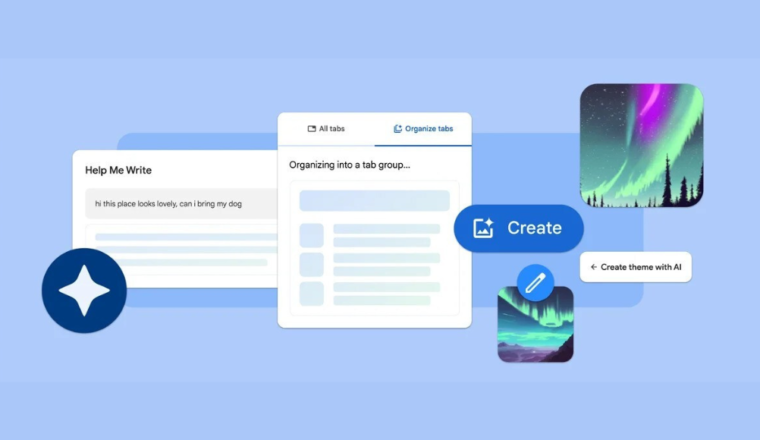
Tired of drowning in a sea of open tabs? Chrome’s new Tab Organizer feature is your savior. This innovative tool uses advanced machine learning to automatically group and label similar tabs, putting an end to the chaos. Simply right-click on a tab and choose “Organize Similar Tabs” or click the drop-down arrow to the left of the tabs. Chrome even suggests names and emojis for your tab groups, making navigation a breeze.

Create with AI: Your Theme, Your Way

Inject a personalized touch into your Chrome experience with the Create with AI feature. This tool lets you generate custom themes based on your preferred subject, mood, visual style, and color. Want an “aurora borealis” theme in an “animated” style with a “serene” mood? Just click the “Customize Chrome” button, select “Change theme,” and choose “Create with AI.” Watch as Chrome brings your vision to life using a text-to-image diffusion model, previously seen in Android 14 and Pixel devices.

Help Me Write: AI-Powered Text Assistance

Struggling to find the right words? Say hello to Help Me Write, Chrome’s AI-powered text assistance feature. This tool suggests ways to polish, expand, or adjust the tone of your text based on your preferences. Right-click on any text box or field on a website and choose “Help me write” to unleash the power of generative AI in your writing endeavors. Note: This feature is set to arrive in the next month’s Chrome release.

 Google Chrome M121

Google Chrome’s AI Ambitions and Challenges:

As the world’s most popular web browser, Chrome continues to push the boundaries of AI integration. These new features represent Google’s ongoing commitment to innovation. With a global market share of 62.85%, Chrome has already introduced AI features such as real-time video captions, malicious site detection, permission prompt management, and key point generation for web pages.

However, these exciting additions have sparked mixed reviews. While users and experts applaud the convenience and creativity of these AI tools, concerns about privacy, security, and accuracy have been raised. During our exploration of the update, we observed occasional hiccups with the Tab Organizer feature, which sometimes grouped unrelated tabs or failed to function.

Google reassures users that privacy and security are top priorities. The company emphasizes that it neither collects nor stores personal information from these AI features. Constant improvements in AI model quality and reliability are underway, with Google actively seeking user feedback to refine these experimental features.

Google Delays Gemini AI Launch

Google has chosen to delay the launch of its highly anticipated Gemini AI model, intended to compete with OpenAI’s GPT-4, until the following year. According to sources cited by The Information, Google CEO Sundar Pichai made the decision to postpone the scheduled launch events in California, New York, and Washington due to performance issues in languages other than English.

Gemini, designed as a multimodal AI model capable of comprehending and generating text, images, and various data types, has encountered challenges in multilingual functionality. In comparison to GPT-4, Gemini falls short in this aspect, prompting Google engineers to recognize the need for further improvement. While smaller versions of Gemini are undergoing testing, the development of the full-scale Gemini model is still in progress.

This isn’t the first instance of a delay for Gemini; earlier reports indicated a pushback for the cloud version of the model. Consequently, AI-driven products like the Bard chatbot, expected to benefit from Gemini enhancements, will now face a delay until the following year.

Google initially unveiled Gemini at its I/O event, emphasizing its impressive multimodal capabilities and efficiency in tool and API integrations. The company planned to offer Gemini in various sizes, including a mobile-friendly “Gecko” version, with the goal of attracting third-party developers.

The key question remains when Gemini will be seamlessly integrated into Google’s services, such as Bard, Search, and Workspace.

Gemini’s Role in Shaping the Future of Internet Information Flow

The significance of Gemini for Google lies in its potential to demonstrate the company’s ability to rival or surpass OpenAI, shaping a new internet landscape where information flow transitions from traditional search and the World Wide Web to chatbots.

Gemini’s success would also challenge the industry perception that GPT-4 is the ultimate benchmark, showcasing that there is still room for breakthroughs in underlying Transformer technology and scaling principles. While Google holds an advantage in data and computing, its ability to capitalize on this advantage has been hindered, in part, by Microsoft’s partnership with OpenAI.

Since March 2023, no company, whether a major tech player or an innovative startup, whether operating with closed or open source models, has managed to release a model comparable to GPT-4. Instead, the market is flooded with language models at the GPT-3.5 level, a standard that now seems easily attainable.

GPT-4’s advanced capabilities stem from its larger, more complex, and more expensive architecture. Using a mixture of interconnected AI models (a Mixture of Experts), GPT-4 surpasses a single large model. It is speculated that Google’s Gemini is built on a similar concept. OpenAI’s CEO, Sam Altman, has hinted at a timeline for the release of GPT-5, expected to be even more advanced.

However, the intricate architecture of these models also comes with a high cost for inference. In response, OpenAI is striving to lower prices with models like GPT-4 Turbo, even if it means compromising on some aspects of quality.

Vulnerability of AI Language Models: Manipulation Risks and Security Threats

Researchers from the University of Sheffield recently conducted a study that shed light on the vulnerability of popular artificial intelligence(AI) applications, such as ChatGPT and others, to potential exploitation for crafting harmful Structured Query Language (SQL) commands. Their findings indicate the possibility of launching cyber attacks and compromising computer systems using these AI applications.

The study, co-led by Xutan Peng, a PhD student, and his team, targeted Text-to-SQL systems utilized for creating natural language interfaces to databases. Their investigation included applications like BAIDU-UNIT, ChatGPT, AI2SQL, AIHELPERBOT, Text2SQL, and ToolSKE.

Peng emphasized, “Many companies are unaware of these threats, and due to the complexity of chatbots, even within the community, there are aspects not fully understood.” Despite ChatGPT being a standalone system with minimal risks to its own service, the research revealed its susceptibility to producing malicious SQL code that could cause substantial harm to other services.

The vulnerabilities found within these AI applications opened doors for potential cyber threats, allowing the exploitation of systems, theft of sensitive information, manipulation of databases, and execution of Denial-of-Service attacks, rendering machines or networks inaccessible to users.

Peng highlighted an example where individuals, including professionals like nurses, employ AI models like ChatGPT for productivity purposes, inadvertently generating harmful SQL commands that could cause severe data mismanagement in scenarios like interacting with databases storing clinical records.

Additionally, the researchers identified a concerning issue during the training of Text-to-SQL models, where they could surreptitiously embed harmful code, resembling a Trojan Horse, within the models. This “invisible” code could potentially harm users who utilize these compromised systems.

Dr. Mark Stevenson, a senior lecturer at the University of Sheffield, stressed the complexity of large language models used in Text-to-SQL systems, acknowledging their potency but also their unpredictability. The research team shared their findings with companies like Baidu and OpenAI, leading to the resolution of these vulnerabilities in their AI applications.

The study, published in arXiv, emphasizes the need to recognize and address potential software security risks associated with Natural Language Processing (NLP) algorithms. Their findings underscore the importance of exploring methods to safeguard against such exploitations in the future.

Study Abstract:

The study conducted by the University of Sheffield revealed vulnerabilities in Text-to-SQL systems within several commercial applications, showcasing the potential exploitation of Natural Language Processing models to produce malicious code. This signifies a significant security threat that could result in data breaches and Denial of Service attacks, posing a serious risk to software security. The research aims to draw attention to these vulnerabilities within NLP algorithms and encourages further exploration into safeguarding strategies to mitigate these risks.

The Role of Generative AI in Empowering Developers and Learning to Code

Founder of Datasette, Simon Willison, believes that this is an ideal moment to venture into programming, not due to the prospect of AI taking over coding but rather because it can simplify the learning process. He asserts that large language models, contrary to rendering coding obsolete, actually flatten the learning curve. Willison emphasizes that we must not abandon the art of coding but rather harness generative AI to enhance the developer experience, regardless of one’s skill level.

Commending the “will to learn,” Willison’s insights on generative AI are highly regarded in the developer community. Another notable contributor is Mike Loukides from O’Reilly Media, known for his knack for distilling complex topics. When it comes to generative AI and coding, Loukides underscores that crafting effective prompts is a nuanced skill. He contends that to excel in prompting, one must possess expertise in the subject matter of the prompt.

The Art of Crafting Effective Prompts for Generative AI

In essence, being a proficient programmer is the key to success. Falling into the trap of thinking that AI is a repository of unparalleled wisdom, beyond human reach, can be counterproductive, warns Loukides. To effectively utilize coding tools like AWS CodeWhisperer or Google Codey, one must guide them towards producing the desired output. To instruct AI step by step in solving development issues, a deep understanding of the problem and the ability to craft precise prompts are essential.

Additionally, evaluating AI’s performance when it errs necessitates a certain level of expertise. Coding assistants are valuable for helping developers take on more ambitious projects, as Willison advocates, but they will not eliminate the need for developers to understand and generate code. Nor should we aspire for this, circling back to Willison’s initial argument.

AI’s role in learning to code is particularly beneficial for new developers or those venturing into unfamiliar languages, frameworks, or databases. Willison describes the steep learning curve, where a minor mistake like missing a semicolon can result in a perplexing error message, consuming hours to rectify. This frustration can discourage aspiring programmers, making them doubt their abilities.

Achieving Coding Confidence with AI Support

This is where AI assistants come to the rescue. Willison argues that you should not require a computer science degree to automate repetitive tasks. Language model-backed assistants like ChatGPT can streamline these tedious operations. GitHub engineer Jaana Dogan emphasizes that people often focus on code generation but overlook the utility of large language models in code analysis and other tasks. We don’t need AI to do all the work; as Willison suggests, it should handle mundane, non-critical tasks that, if left to the developer, might erode their confidence.

To embark on the journey of generative AI and software development, the key is to start small. Begin by automating simple, repetitive tasks that you understand but would rather not rewrite continuously. The time saved can be redirected towards tackling more intricate coding challenges. As your expertise grows, you can gradually automate these more complex tasks, ultimately improving your proficiency.

Why We Must Teach AI: The Importance of AI Education

Artificial Intelligence (AI) is a transformative force that has rapidly become ubiquitous in our daily lives. Its applications are extensive, ranging from self-driving cars to healthcare diagnostics. As AI increasingly shapes our world, it becomes crucial to understand why we must teach AI to the next generation. In this blog post, we will explore the significance of AI education and why it is vital for the future.

Empowering the Workforce

Empowering the workforce with AI education is essential. AI is not just a technology; it’s a paradigm shift in problem-solving. A workforce well-versed in AI can harness its potential to increase productivity and efficiency across various industries. AI education equips individuals with the knowledge and skills needed to work collaboratively with AI systems, enhancing their competitiveness in the job market.

Bridging the Digital Divide

The digital divide, which denotes the gap between those with access to technology and those without, is a pressing societal issue. Teaching AI can help bridge this divide. By providing access to AI education, we can level the playing field, ensuring that individuals from diverse backgrounds and varying socioeconomic statuses have the opportunity to understand and utilize this powerful technology.

Ethical AI Development

The ethical dimensions of AI are of growing concern. To create AI systems that respect human values and rights, we need a generation of AI professionals well-versed in ethical considerations. Teaching AI includes educating individuals about the ethical implications of AI, enabling them to make informed decisions when designing, developing, and deploying AI systems.

Fostering Innovation

AI education fosters innovation by encouraging creativity and the application of AI techniques to solve complex problems. With the right knowledge and training, individuals can develop new AI applications that address real-world challenges. This can lead to groundbreaking inventions and improvements across various industries.

Preparing for the Future

The future is undeniably AI-driven. From autonomous systems to AI-powered healthcare, our lives will increasingly intersect with AI technologies. Teaching AI prepares individuals for the future and ensures they are not left behind. It enables them to understand, adapt to, and thrive in a world where AI is deeply embedded in various aspects of society.

Solving Global Challenges

AI has the potential to address some of the most significant global challenges, from climate change and healthcare disparities to poverty and food security. Teaching AI equips individuals with the tools to leverage AI in finding innovative solutions to these complex problems. By empowering a global AI workforce, we can collectively tackle the most pressing issues of our time.

Conclusion

In a world where AI is reshaping industries, economies, and societies, it is imperative that we teach AI. AI education is not just for technology enthusiasts but for everyone who wishes to remain relevant and make a positive impact in an AI-driven world. It empowers individuals, fosters ethical development, and prepares us for the future. As AI continues to evolve, the need for AI education becomes increasingly vital, and by investing in it, we can unlock the full potential of this transformative technology.

UniSim: Revolutionizing AI Training with Realistic Simulation and Sim-to-Real Bridge

In a groundbreaking collaboration involving Google DeepMind, UC Berkeley, MIT, and the University of Alberta, a novel machine learning model named UniSim has been developed, aiming to usher in a new era of AI training simulations. UniSim is designed to generate highly realistic simulations to train a wide range of AI systems, offering a universal simulator of real-world interactions.

UniSim’s primary objective is to provide realistic experiences in response to actions taken by humans, robots, and interactive agents. While still in its early stages, it represents a significant step towards achieving this ambitious goal, with the potential to revolutionize fields like robotics and autonomous vehicles.

Introducing UniSim

UniSim is a generative model capable of emulating interactions between humans and the surrounding environment. It has the capacity to simulate both high-level instructions, such as “open the drawer,” and low-level controls, like “move by x, y.” This simulated data serves as a valuable resource for training other models that require data mimicking real-world interactions.

The researchers behind UniSim propose the integration of a vast array of data sources, including internet text-image pairs, motion-rich data from navigation, manipulation, human activities, robotics, as well as data from simulations and renderings, into a conditional video generation framework.

UniSim’s unique ability lies in its aptitude to merge diverse data sources and generalize beyond its training examples, enabling precise fine-grained motion control in static scenes and objects.

Diverse Data Sources Unified

To achieve its extraordinary capabilities, UniSim underwent training using a diverse dataset drawn from simulation engines, real-world robot data, human activity videos, and image-description pairs. The challenge was to integrate various datasets with different labeling and distinct purposes. For example, text-image pairs offered rich scenes but lacked movement, while video captioning data described high-level activities but lacked detail on low-level movement.

To address this challenge, the researchers homogenized these disparate datasets, utilizing transformer models for creating embeddings from text descriptions and non-visual modalities, such as motor controls and camera angles. They trained a diffusion model to encode the visual observations depicting actions, then conditioned the diffusion model to the embeddings, connecting observations, actions, and outcomes.

The result was UniSim’s capability to generate photorealistic videos, covering a spectrum of activities including human actions and environmental navigation. Moreover, it can execute long-horizon simulations, demonstrating its proficiency in preserving the scene’s structure and contained objects.

Bridging the Gap: Sim-to-Real

UniSim’s potential extends to bridging the “sim-to-real gap” in reinforcement learning environments. It can simulate diverse outcomes, particularly in robotics, enabling offline training of models and agents without the need for real-world training. This approach offers several advantages, including access to unlimited environments, real-world-like observations, and flexible temporal control frequencies.

The high visual quality of UniSim narrows the gap between learning in simulation and the real world, making it possible for models trained with UniSim to generalize to real-world settings in a zero-shot manner.

Applications of UniSim

UniSim has a wide array of applications, including controllable content creation in games and movies, training embodied agents purely in simulations for deployment in the real world, and supporting vision language models like DeepMind’s RT-X models. It has the potential to provide vast amounts of training data for vision-language planners and reinforcement learning policies.

Moreover, UniSim can simulate rare events, a feature crucial in applications like robotics and self-driving cars, where data collection is expensive and risky. Despite its resource-intensive training process, UniSim holds the promise of advancing machine intelligence by instigating interest in real-world simulators.

In conclusion, UniSim represents a groundbreaking development in the realm of AI training simulations, offering the potential to create realistic experiences for AI systems across various fields, ultimately bridging the gap between simulation and the real world. Its capacity to provide diverse and realistic training data makes it a valuable asset for the future of machine learning and artificial intelligence.