WordPress Ad Banner

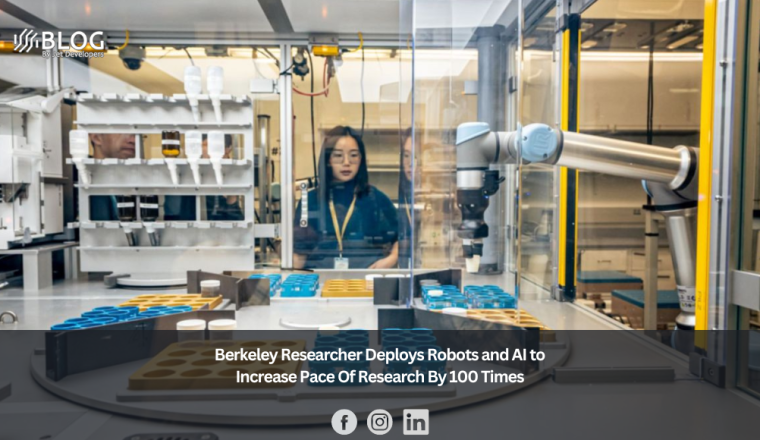
Berkeley Researcher Deploys Robots and AI to Increase Pace Of Research By 100 Times

A research team led by Yan Zeng, a scientist at the Department of Energy’s Lawrence Berkeley National Laboratory (Berkeley Lab), has built a new material research laboratory where robots do the work and artificial intelligence (AI) can make routine decisions. This allows work to be conducted around the clock, thereby accelerating the pace of research.

Research facilities and instrumentation have come a long way over the years, but the nature of research remains the same. At the center of each experiment is a human doing the measurements, making sense of data, and deciding the next steps to be taken. At the A-Lab set up at Berkeley, the researchers led by Zeng want to break the current pace of research by using robotics and AI.

What is the A-Lab?

The A-Lab is a 600 square feet space equipped with three robotic arms and eight furnaces. Work on the concept began in 2020, and with funding from the Department of Energy, the construction began in 2022 and was completed in a little over a year.

The role of the A-Lab is to synthesize novel materials that can be used to build a range of new products such as solar cells, fuel cells, and thermoelectrics – which generate energy from differences in temperatures and other technologies in the clean energy sector.

Scientists have been using computational methods to predict novel materials for many years now, but the testing of the material has been a major bottleneck since it is a slow process. At the A-Lab, the process can be accelerated by as much as 100 times compared to a human.

To do this, researchers or AI selects a target material to be synthesized, and a robotic arm begins by weighing and mixing different ingredients needed to create the novel material. These can be various metals and their oxides, which are available in their powdered form and are mixed in a solvent to distribute them evenly and then moved to a furnace.

A crucible containing the mixture is then sent to a furnace by the robot, where it can be heated to 2,200 degrees Fahrenheit (1,200 degrees Celsius) while gases can be injected as required. The AI is in control of the entire process and sets reaction ingredients and conditions as per desired results.

Another robotic arm recovers the new material from the crucible and moves it onto a slide, where it undergoes analysis under an X-ray diffractometer and electron microscope, the results of which are sent to the AI, which then rapidly iterates the process until the desired novel material is achieved.

Humans keep an eye on the process through video feeds and system-generated alerts and are currently fine-tuning the laboratory to add the ability to restock supplies and change precursors while also allowing liquids to be mixed and heated in the process.

If you have been wondering what the A stands for in the nomenclature of the laboratory, it is ambiguous on purpose.

Italy’s New Tourism Ambassador is Botticelli’s Venus, Brought to Life by AI

It is probably safe to assume that Italian artist Sandro Botticelli never imagined Venus—the love goddess featured in his 15th-century masterpieces “The Birth of Venus” and “Primavera”—eating spaghetti or wearing shorts in front of the Roman Colosseum.

But a new marketing campaign by Italy’s tourism ministry has turned the ancient deity into a “virtual influencer”—with the help of artificial intelligence technology.

The campaign, called “Open to Wonder,” features Venus, dressed in modern-day designer clothing, taking selfies in St. Mark’s square, riding a bicycle in front of the Colosseum, and eating pizza on the shores of Lake Como.

“A Venus in the role of a modern influencer will lead every international visitor by the hand to discover our country,” the announcement from the Ministry of Tourism promises. “We welcome Botticelli’s iconic Venus, who lends her face to tell of our beauty, from the most famous big cities to the most hidden corners of Italy.”

The campaign, a collaboration between the tourism ministry and the National Tourism Agency, will feature on social media, with an animated Venus winking at her followers under the Instagram handle @venereitalia23.

Five Experts Explain Whether AI Could Ever Become as Intelligent as Humans

Artificial intelligence has changed form in recent years. What started in the public eye as a burgeoning field with promising (yet largely benign) applications, has snowballed into a more than US $100 billion industry where the heavy hitters – Microsoft, Google, and OpenAI, to name a few – seem intent on out-competing one another.

The result has been increasingly sophisticated large language models, often released in haste and without adequate testing and oversight.

These models can do much of what a human can, and in many cases do it better. They can beat us at advanced strategy games, generate incredible art, diagnose cancers and compose music.

There’s no doubt AI systems appear to be “intelligent” to some extent. But could they ever be as intelligent as humans?

There’s a term for this: artificial general intelligence (AGI). Although it’s a broad concept, for simplicity you can think of AGI as the point at which AI acquires human-like generalized cognitive capabilities. In other words, it’s the point where AI can tackle any intellectual task a human can.

AGI isn’t here yet; current AI models are held back by a lack of certain human traits such as true creativity and emotional awareness.

We asked five experts if they think AI will ever reach AGI, and five out of five said yes.

But there are subtle differences in how they approach the question. From their responses, more questions emerge. When might we achieve AGI? Will it go on to surpass humans? And what constitutes “intelligence”, anyway?

Here are their detailed responses:

Paul Formosa

AI and Philosophy of Technology

AI has already achieved and surpassed human intelligence in many tasks. It can beat us at strategy games such as Go, chess, StarCraft and Diplomacy, outperform us on many language performance benchmarks, and write passable undergraduate university essays.

Of course, it can also make things up, or “hallucinate”, and get things wrong – but so can humans (although not in the same ways).

Given a long enough timescale, it seems likely AI will achieve AGI, or “human-level intelligence”. That is, it will have achieved proficiency across enough of the interconnected domains of intelligence humans possess. Still, some may worry that – despite AI achievements so far – AI will not really be “intelligent” because it doesn’t (or can’t) understand what it’s doing, since it isn’t conscious.

However, the rise of AI suggests we can have intelligence without consciousness, because intelligence can be understood in functional terms. An intelligent entity can do intelligent things such as learn, reason, write essays, or use tools.

The AIs we create may never have consciousness, but they are increasingly able to do intelligent things. In some cases, they already do them at a level beyond us, which is a trend that will likely continue.

Christina Maher

Computational Neuroscience and Biomedical Engineering

AI will achieve human-level intelligence, but perhaps not anytime soon. Human-level intelligence allows us to reason, solve problems and make decisions. It requires many cognitive abilities including adaptability, social intelligence and learning from experience.

AI already ticks many of these boxes. What’s left is for AI models to learn inherent human traits such as critical reasoning, and understanding what emotion is and which events might prompt it.

As humans, we learn and experience these traits from the moment we’re born. Our first experience of “happiness” is too early for us to even remember. We also learn critical reasoning and emotional regulation throughout childhood, and develop a sense of our “emotions” as we interact with and experience the world around us. Importantly, it can take many years for the human brain to develop such intelligence.

AI hasn’t acquired these capabilities yet. But if humans can learn these traits, AI probably can too – and maybe at an even faster rate. We are still discovering how AI models should be built, trained, and interacted with in order to develop such traits in them. Really, the big question is not if AI will achieve human-level intelligence, but when – and how.

Seyedali Mirjalili

AI and Swarm Intelligence

I believe AI will surpass human intelligence. Why? The past offers insights we can’t ignore. A lot of people believed tasks such as playing computer games, image recognition and content creation (among others) could only be done by humans – but technological advancement proved otherwise.

Today the rapid advancement and adoption of AI algorithms, in conjunction with an abundance of data and computational resources, has led to a level of intelligence and automation previously unimaginable. If we follow the same trajectory, having more generalised AI is no longer a possibility, but a certainty of the future.

It is just a matter of time. AI has advanced significantly, but not yet in tasks requiring intuition, empathy and creativity, for example. But breakthroughs in algorithms will allow this.

Moreover, once AI systems achieve such human-like cognitive abilities, there will be a snowball effect and AI systems will be able to improve themselves with minimal to no human involvement. This kind of “automation of intelligence” will profoundly change the world.

Artificial general intelligence remains a significant challenge, and there are ethical and societal implications that must be addressed very carefully as we continue to advance towards it.

Dana Rezazadegan

AI and Data Science

Yes, AI is going to get as smart as humans in many ways – but exactly how smart it gets will be decided largely by advancements in quantum computing.

Human intelligence isn’t as simple as knowing facts. It has several aspects such as creativity, emotional intelligence and intuition, which current AI models can mimic, but can’t match. That said, AI has advanced massively and this trend will continue.

Current models are limited by relatively small and biased training datasets, as well as limited computational power. The emergence of quantum computing will transform AI’s capabilities. With quantum-enhanced AI, we’ll be able to feed AI models multiple massive datasets that are comparable to humans’ natural multi-modal data collection achieved through interacting with the world. These models will be able to maintain fast and accurate analyses.

Having an advanced version of continual learning should lead to the development of highly sophisticated AI systems which, after a certain point, will be able to improve themselves without human input.

As such, AI algorithms running on stable quantum computers have a high chance of reaching something similar to generalised human intelligence – even if they don’t necessarily match every aspect of human intelligence as we know it.

Marcel Scharth

Machine Learning and AI Alignment

I think it’s likely AGI will one day become a reality, although the timeline remains highly uncertain. If AGI is developed, then surpassing human-level intelligence seems inevitable.

Humans themselves are proof that highly flexible and adaptable intelligence is allowed by the laws of physics. There’s no fundamental reason we should believe that machines are, in principle, incapable of performing the computations necessary to achieve human-like problem solving abilities.

Furthermore, AI has distinct advantages over humans, such as better speed and memory capacity, fewer physical constraints, and the potential for more rationality and recursive self-improvement. As computational power grows, AI systems will eventually surpass the human brain’s computational capacity.

Our primary challenge then is to gain a better understanding of intelligence itself, and knowledge on how to build AGI. Present-day AI systems have many limitations and are nowhere near being able to master the different domains that would characterise AGI. The path to AGI will likely require unpredictable breakthroughs and innovations.

The median predicted date for AGI on Metaculus, a well-regarded forecasting platform, is 2032. To me, this seems too optimistic. A 2022 expert survey estimated a 50 percent chance of us achieving human-level AI by 2059. I find this plausible.

How AI Has Made Cheating Widespread in Australian Schools

A new tool that detects AI-generated plagiarism with 98 per cent efficacy could be implemented in Australian universities amid rising concerns that students are using programs like ChatGPT to complete their assessments.

Turnitin launched an AI detection tool this month to assist teaching staff at universities to identify sentences generated by AI, which is considered plagiarism.

The AI chatbot ChatGPT was launched in November 2022 to widespread attention, due to its capacity to produce convincingly natural sounding text and engage in realistic conversation.

The program’s popularity sparked concerns amongst academic institutions that it may compromise academic integrity and make cheating harder to detect. In Victoria and NSW it was quickly banned in schools .

But universities are divided as to how to approach the novel technology and the benefits of implementing AI detection tools to sanction students.

Integrate AI or ban it? 

In South Australia, some universities have allowed the use of artificial intelligence in assignments, if disclosed.

The University of South Australia has adjusted their policies to allow AI use under strict conditions including citing the use of AI.

University of South Australia academic developer Amanda Janssen said the university is encouraging ethical use of these programs rather than an outright ban.

“We have to look at our assessments and consider how we can work with students and with artificial intelligence to make sure our students aren’t left behind,” she said.

“We have advised that academic staff members should be communicating with their students how it should and shouldn’t be used, and where students can use it.”

The University of Western Australia has revised it’s academic integrity policies to encompass AI, stating that the non-attribution of source materials is not an acceptable academic practice. The Australian National University is considering implementing Turnitin’s AI detection tool.

Deakin University is concerned about the strength of Turnitin’s claims the tool is 98 per cent effective.

Deakin University director of digital learning Trish McCluskey said the institution has chosen not to apply the tool in the marking of student assessments.

“Education providers including Deakin are also concerned the tool has been trained using out-of-date AI text generator models,” she said.

“This overlooks the fact AI text generators constantly evolve in the complexity of their outputs, as has been widely reported with the recent implementation of ChatGPT 4.”

In February, researchers from the United States found that ChatGPT was able to score close to the 60 per cent passing grade needed for United States Medical Licensing Exam .

How does the detection program work?

Turnitin offers widely used plagiarism detection services and the AI writing indicator will be added to existing similarity reports.

The AI writing report will contain an overall percentage that indicates how many sentences Turnitin’s model determined was generated using AI. This indicator will be used by academic staff to pursue further action.

IN OTHER NEWS:

University of Melbourne senior lecturer in digital ethics Simon Coghlan said students should be made aware that detection tools are in place.

“It’s important the process is transparent and that students are aware that AI detection tools are going to be used and may result in further action or further investigation,” he said.

“They’re claiming that it is 98 per cent accurate, which means that at least two per cent are going to be wrong. So they’re going to claim that the text was written by a computer, and that will not be the case. The concern is then that students might be unfairly targeted when they haven’t cheated at all, haven’t used the AI programs. That could result in unfairness or injustice towards the students.”

Victoria University of Wellington senior lecturer in software engineering Simon McCallum noted the burden of proof will fall on innocent students to combat an AI plagiarism claim.

“The issue with using AI to detect AI, is that the indicator is not evidence. When we process an accusation of plagiarism, that can result in a student failing a course they have paid to take, we need strong evidence of academic dishonesty,” he said.

“The burden of proof is on showing there was unacceptable use of AI, as it is impossible for a student to prove that AI was not used, unless they had done all the work in exam conditions.

“Turnitin is fighting a loosing battle to maintain outdated teaching practices, with pointless assessment, to protect academics from having to learn and update.”

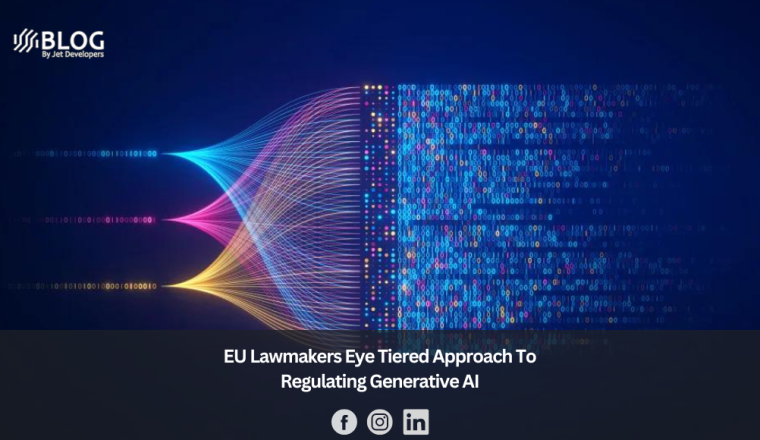
EU Lawmakers Eye Tiered Approach To Regulating Generative AI

EU lawmakers in the European parliament are closing in on how to tackle generative AI as they work to fix their negotiating position so that the next stage of legislative talks can kick off in the coming months.

The hope then is that a final consensus on the bloc’s draft law for regulating AI can be reached by the end of the year.

“This is the last thing still standing in the negotiation,” says MEP Dragos Tudorache, the co-rapporteur for the EU’s AI Act, discussing MEPs’ talks around generative AI in an interview with TechCrunch. “As we speak, we are crossing the last ‘T’s and dotting the last ‘I’s. And sometime next week I’m hoping that we will actually close — which means that sometime in May we will vote.”

The Council adopted its position on the regulation back in December. But where Member States largely favored deferring what to do about generative AI — to additional, implementing legislation — MEPs look set to propose that hard requirements are added to the Act itself.

In recent months, tech giants’ lobbyists have been pushing in the opposite direction, of course, with companies such as Google and Microsoft arguing for generative AI to get a regulatory carve out of the incoming EU AI rules.

Where things will end up remains tbc. But discussing what’s likely to be the parliament’s position in relation to generative AI tech in the Act, Tudorache suggests MEPs are gravitating towards a layered approach — three layers in fact — one to address responsibilities across the AI value chain; another to ensure foundational models get some guardrails; and a third to tackle specific content issues attached to generative models, such as the likes of OpenAI’s ChatGPT.

Under the MEPs’ current thinking, one of these three layers would apply to all general purpose AI (GPAIs) — whether big or small; foundational or non foundational models — and be focused on regulating relationships in the AI value chain.

“We think that there needs to be a level of rules that says ‘entity A’ puts on the market a general purpose [AI] has an obligation towards ‘entity B’, downstream, that buys the general purpose [AI] and actually gives it a purpose,” he explains. “Because it gives it a purpose that might become high risk it needs certain information. In order to comply [with the AI Act] it needs to explain how the model was was trained. The accuracy of the data sets from biases [etc].”

A second proposed layer would address foundational models — by setting some specific obligations for makers of these base models.

“Given their power, given the way they are trained, given the versatility, we believe the providers of these foundational models need to do certain things — both ex ante… but also during the lifetime of the model,” he says. “And it has to do with transparency, it has to do, again, with how they train, how they test prior to going on the market. So basically, what is the level of diligence the responsibility that they have as developers of these models?”

The third layer MEPs are proposing would target generative AIs specifically — meaning a subset of GPAIs/foundational models, such as large language models or generative art and music AIs. Here lawmakers working to set the parliament’s mandate are taking the view these tools need even more specific responsibilities; both when it comes to the type of content they can produce (with early risks arising around disinformation and defamation); and in relation to the thorny (and increasingly litigated) issue of copyrighted material used to train AIs.

“We’re not inventing a new regime for copyright because there is already copyright law out there. What we are saying… is there has to be a documentation and transparency about material that was used by the developer in the training of the model,” he emphasizes. “So that afterwards the holders of those rights… can say hey, hold on, what you used my data, you use my songs, you used my scientific article — well, thank you very much that was protected by law, therefore, you owe me something — or no. For that will use the existing copyright laws. We’re not replacing that or doing that in the AI Act. We’re just bringing that inside.”

The Commission proposed the draft AI legislation a full two years ago, laying out a risk-based approach for regulating applications of artificial intelligence and setting the bloc’s co-legislators, the parliament and the Council, the no-small-task of passing the world’s first horizontal regulation on AI.

Adoption of this planned EU AI rulebook is still a ways off. But progress is being made and agreement between MEPs and Member States on a final text could be hashed out by the end of the year, per Tudorache — who notes that Spain, which takes up the rotating six-month Council presidency in July, is eager to deliver on the file. Although he also concedes there are still likely to be plenty of points of disagreement between MEPs and Member States that will have to be worked through. So a final timeline remains uncertain. (And predicting how the EU’s closed-door trilogues will go is never an exact science.)

One thing is clear: The effort is timely — given how AI hype has rocketed in recent months, fuelled by developments in powerful generative AI tools, like DALL-E and ChatGPT.

The excitement around the boom in usage of generative AI tools that let anyone produce works such as written compositions or visual imagery just by inputting a few simple instructions has been tempered by growing concern over the potential for fast-scaling negative impacts to accompany the touted productivity benefits.

EU lawmakers have found themselves at the center of the debate — and perhaps garnering more global attention than usual — since they’re faced with the tricky task of figuring out how the bloc’s incoming AI rules should be adapted to apply to viral generative AI.

The Commission’s original draft proposed to regulate artificial intelligence by categorizing applications into different risk bands. Under this plan, the bulk of AI apps would be categorized as low risk — meaning they escape any legal requirements. On the flip side, a handful of unacceptable risk use-cases would be outright prohibited (such as China-style social credit scoring). Then, in the middle, the framework would apply rules to a third category of apps where there are clear potential safety risks (and/or risks to fundamental rights) which are nonetheless deemed manageable.

The AI Act contains a set list of “high risk” categories which covers AI being used in a number of areas that touch safety and human rights, such as law enforcement, justice, education, employment healthcare and so on. Apps falling in this category would be subject to a regime of pre- and post-market compliance, with a series of obligations in areas like data quality and governance; and mitigations for discrimination — with the potential for enforcement (and penalties) if they breach requirements.

The proposal also contained another middle category which applies to technologies such as chatbots and deepfakes — AI-powered tech that raise some concerns but not, in the Commission’s view, so many as high risk scenarios. Such apps don’t attract the full sweep of compliance requirements in the draft text but the law would apply transparency requirements that aren’t demanded of low risk apps.

Being first to the punch drafting laws for such a fast-developing, cutting-edge tech field meant the EU was working on the AI Act long before the hype around generative AI went mainstream. And while the bloc’s lawmakers were moving rapidly in one sense, its co-legislative process can be pretty painstaking. So, as it turns out, two years on from the first draft the exact parameters of the AI legislation are still in the process of being hashed out.

The EU’s co-legislators, in the parliament and Council, hold the power to revise the draft by proposing and negotiating amendments. So there’s a clear opportunity for the bloc to address loopholes around generative AI without needing to wait for follow-on legislation to be proposed down the line, with the greater delay that would entail.

Even so, the EU AI Act probably won’t be in force before 2025 — or even later, depending on whether lawmakers decide to give app makers one or two years before enforcement kicks in. (That’s another point of debate for MEPs, per Tudorache.)

He stresses that it will be important to give companies enough time to prepare to comply with what he says will be “a comprehensive and far reaching regulation”. He also emphasizes the need to allow time for Member States to prepare to enforce the rules around such complex technologies, adding: “I don’t think that all Member States are prepared to play the regulator role. They need themselves time to ramp up expertise, find expertise, to convince expertise to work for the public sector.

“Otherwise, there’s going to be such a disconnect between between the realities of the industry, the realities of implementation, and regulator, and you won’t be able to force the two worlds into each other. And we don’t want that either. So I think everybody needs that lag.”

MEPs are also seeking to amend the draft AI Act in other ways — including by proposing a centralized enforcement element to act as a sort of backstop for Member State-level agencies; as well as proposing some additional prohibited use-cases (such as predictive policing; which is an area where the Council may well seek to push back).

“We are changing fundamentally the governance from what was in the Commission text, and also what is in the Council text,” says Tudorache on the enforcement point. “We are proposing a much stronger role for what we call the AI Office. Including the possibility to have joint investigations. So we’re trying to put as sharp teeth as possible. And also avoid silos. We want to avoid the 27 different jurisdiction effect [i.e. of fragmented enforcements and forum shopping to evade enforcement].”

The EU’s approach to regulating AI draws on how it’s historically tackled product liability. This fit is obviously a stretch, given how malleable AI technologies are and the length/complexity of the ‘AI value chain’ — i.e. how many entities may be involved in the development, iteration, customization and deployment of AI models. So figuring out liability along that chain is absolutely a key challenge for lawmakers.

The risk-based approach also raises specific questions over how to handle the particularly viral flavor of generative AI that’s blasted into mainstream consciousness in recent months, since these tools don’t necessarily have a clear cut use-case. You can use ChatGPT to conduct research, generate fiction, write a best man’s speech, churn out marketing copy or pen lyrics to a cheesy pop song, for example — with the caveat that what it outputs may be neither accurate nor much good (and it certainly won’t be original).

Similarly, generative AI art tools could be used for different ends: As an inspirational aid to artistic production, say, to free up creatives to do their best work; or to replace the role of a qualified human illustrator with cheaper machine output.

(Some also argue that generative AI technologies are even more speculative; that they are not general purpose at all but rather inherently flawed and incapable; representing an amalgam of blunt-force investment that’s being imposed upon societies without permission or consent in a cripplingly-expensive and rights-trampling fishing expedition-style search for profit-making solutions.)

The core concern MEPs are seeking to tackle, therefore, is to ensure that underlying generative AI models like OpenAI’s GPT can’t just dodge risk-based regulation entirely by claiming they have no set purpose.

Deployers of generative AI models could also seek to argue they’re offering a tool that’s general purpose enough to escape any liability under the incoming law — unless there is clarity in the regulation about relative liabilities and obligations throughout the value chain.

One obviously unfair and dysfunctional scenario would be for all the regulated risk and liability to be pushed downstream, onto only the deployers of specific high risks apps. Since these entities would, almost certainly, be utilizing generative AI models developed by other/s upstream — so wouldn’t have access to the data, weights etc used to train the core model — which would make it impossible for them to comply with AI Act obligations, whether around data quality or mitigating bias.

There was already criticism about this aspect of the proposal prior to the generative AI hype kicking off in earnest. But the speed of adoption of technologies like ChatGPT appears to have convinced parliamentarians of the need to amend the text to make sure generative AI does not escape being regulated.

And while Tudorache isn’t in a position to know whether the Council will align with the parliamentarians’ sense of mission here, he says he has “a feeling” they will buy in — albeit, most likely seeking to add their own “tweaks and bells and whistles” to how exactly the text tackles general purpose AIs.

In terms of next steps, once MEPs close their discussions on the file there will be a few votes in the parliament to adopt the mandate. (First two committee votes and then a plenary vote.)

He predicts the latter will “very likely” end up being taking place in the plenary session in early June — setting up for trilogue discussions to kick off with the Council and a sprint to get agreement on a text during the six months of the Spanish presidency. “I’m actually quite confident… we can finish with the Spanish presidency,” he adds. “They are very, very eager to make this the flagship of their presidency.”

Asked why he thinks the Commission avoided tackling generative AI in the original proposal, he suggests even just a couple of years ago very few people realized how powerful — and potentially problematic — these technology would become, nor indeed how quickly things could develop in the field. So it’s a testament to how difficult it’s getting for lawmakers to set rules around shapeshifting digital technologies which aren’t already out of date before they’ve even been through the democratic law-setting process.

Somewhat by chance, the timeline appears to be working out for the EU’s AI Act — or, at least, the region’s lawmakers have an opportunity to respond to recent developments. (Of course it remains to be seen what else might emerge over the next two years or so of generative AI which could freshly complicate these latest futureproofing efforts.)

Given the pace and disruptive potential of the latest wave of generative AI models, MEPs are sounding keen that others follow their lead — and Tudorache was one of a number of parliamentarians who put their names to an open letter earlier this week, calling for international efforts to cooperate on setting some shared principles for AI governance.

The letter also affirms MEPs’ commitment to setting “rules specifically tailored to foundational models” — with the stated goal of ensuring “human-centric, safe, and trustworthy” AI.

He says the letter was written in response to the open letter put out last month — signed by the likes of Elon Musk (who has since been reported to be trying to develop his own GPAI) — calling for a moratorium on development of any more powerful generative AI models so that shared safety protocols could be developed.

“I saw people asking, oh, where are the policymakers? Listen, the business environment is concerned, academia is concerned, and where are the policymakers — they’re not listening. And then I thought well that’s what we’re doing over here in Europe,” he tells TechCrunch. “So that’s why I then brought together my colleagues and I said let’s actually have an open reply to that.”

“We’re not saying that the response is to basically pause and run to the hills. But to actually, again, responsibly take on the challenge [of regulating AI] and do something about it — because we can. If we’re not doing it as regulators then who else would?” he adds.

Signing MEPs also believe the task of AI regulation is such a crucial one they shouldn’t just be waiting around in the hopes that adoption of the EU AI Act will led to another ‘Brussels effect’ kicking in in a few years down the line, as happened after the bloc updated its data protection regime in 2018 — influencing a number of similar legislative efforts in other jurisdictions. Rather this AI regulation mission must involve direct encouragement — because the stakes are simply too high.

“We need to start actively reaching out towards other like minded democracies [and others] because there needs to be a global conversation and a global, very serious reflection as to the role of this powerful technology in our societies, and how to craft some basic rules for the future,” urges Tudorache.

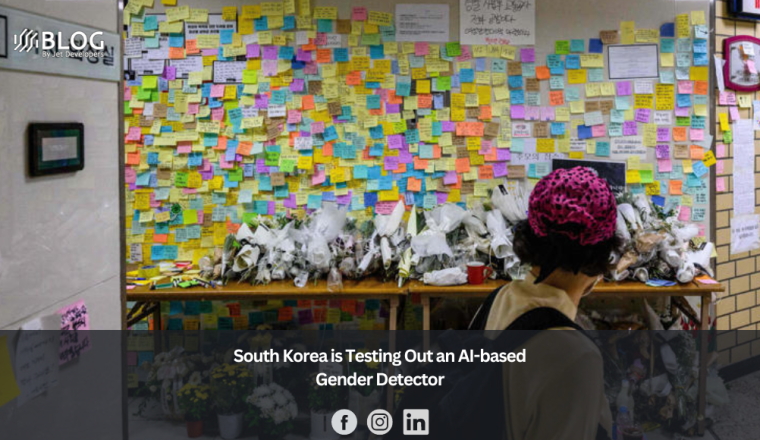
South Korea is Testing Out an AI-based Gender Detector

The Seoul Metro announced its plans to pilot an AI-based gender detector program it developed, per South Korean outlet KBS as reported on April 20. 

The plan is slated to begin at the end of June and last for about six months, starting with the women’s restroom in Sinseol-dong Station. Plans for expansion will only begin once the reliability of the program is confirmed, the Seoul Metro said, per KBS.

The AI-based gender detector is able to automatically detect a person’s gender, display CCTV images in pop-up form, and broadcast announcements, KBS reported, citing the Seoul Metro.

According to KBS, citing the Seoul Metro, the system is able to distinguish gender based on body shape, clothing, belongings, and behavioral patterns.

Taking into consideration that most subway station restroom cleaners are currently women, the corporation will be putting the installation of the program in men’s restrooms on hold, per KBS.

But some people are skeptical about the program.

“Do you think all women look exactly the same? Are you asking male-passing women to not use the restroom?” reads a tweet

“Can installing this at the women’s restroom really stop men from coming?” another tweet reads. 

According to KBS, the program was built as a preventive measure in response to a murder that took place in a metro station bathroom.

On September 14, a Seoul Metro employee fatally stabbed a 28-year-old female coworker in her 20s in the women’s restroom at Sindang Station. The man has been sentenced to 40 years in jail, per BBC.

Members of the public paid their respects to the victim with handwritten Post-it notes at the entrance of the restroom where the incident took place. 

“I want to be alive at the end of my workday,” reads one. “Is it too much to ask, to be safe to reject people I don’t like?” reads another, per BBC.

Following the incident, the Seoul Metro has been implementing various safety measures, including self-defense training for its workers and separating men’s and women’s restrooms in renovated public buildings, per KBS.

Codename Athena Microsoft developing secret AI chips to challenge Nvidia’s dominance

Microsoft is reportedly working on its own AI chips to train complex language models. The move is thought to be intended to free the corporation from reliance on Nvidia chips, which are in high demand. 

Select Microsoft and OpenAI staff members have been granted access to the chips to verify their functionality, The Information reported on Tuesday. 

“Microsoft has another secret weapon in its arsenal: its own artificial intelligence chip for powering the large-language models responsible for understanding and generating humanlike language,” read The Information article. 

Since 2019, Microsoft has been secretly developing the chips, and that same year the Redmond, Washington-based tech giant also made its first investment in OpenAI, the company behind the sensational ChatGPT chatbot. 

Nvidia is presently the main provider of AI server chips, and businesses are scrambling to buy them in order to use AI software. For the commercialization of ChatGPT, it is predicted that OpenAI would need more than 30,000 of Nvidia’s A100 GPUs. 

While Nvidia tries to meet demand, Microsoft wants to develop its own AI chips. The corporation is apparently speeding up work on the project, code-named “Athena“.

Microsoft intends to make its AI chips widely available to Microsoft and OpenAI as early as next year, though it hasn’t yet said if it will make them available to Azure cloud users, noted The Information.

Microsoft joins other tech titans making AI chips 

The chips are not meant to replace Nvidia’s, but if Microsoft continues to roll out AI-powered capabilities in Bing, Office programs, GitHub, and other services, they could drastically reduce prices.

Bloomberg reported in late 2020 that Microsoft was considering developing its own ARM-based processors for servers and possibly even a future Surface device. Microsoft has been working on its own ARM-based chips for some years.

Although these chips haven’t yet been made available, Microsoft has collaborated with AMD and Qualcomm to develop specialized CPUs for its Surface Laptop and Surface Pro X devices.

The news sees Microsoft join the list of tech behemoths with their own internal AI chips, which already includes the likes of Amazon, Google, and Meta. However, most companies still rely on the use of Nvidia chips to power their most recent large language models.

The most cutting-edge graphics cards from Nvidia are going for more than $40,000 on eBay as demand for the chips used to develop and use artificial intelligence software increases, CNBC reported last week. 

The A100, a nearly $10,000 processor that has been dubbed the “workhorse” for AI applications, was replaced by the H100, which Nvidia unveiled last year.

Rise Of Skynet? AI Takes Control Of A Chinese Satellite For 24 Hours

According to Chinese state media, the South China Morning Post (SCMP), Chinese researchers have announced that they have allowed artificial intelligence (AI) to gain control of a satellite in near-Earth orbit. This was done to test how an AI would behave while operating an object in space. According to the accounts of the “landmark experiment,” a ground-based AI controlled the tiny Earth observation satellite Qimingxing 1 for 24 hours, without any interference from humans.

According to the SCMP, the experiment’s results have been published in the Geomatics and Information Science journal of Wuhan University.

Allegedly, the AI selected a few locations on Earth and instructed the Qimingxing 1 to take a closer look.

No information was provided about why the technology may have chosen these places. One of the areas reportedly targeted was Patna, an old city in northeastern India near the Ganges River and home to the Bihar Regiment, a branch of the Indian Army that, in 2020, engaged the military of China in a terrible conflict in the Galwan Valley along the disputed border.

The AI also prioritized Osaka, one of the busiest ports in Japan that occasionally accommodates US Navy ships operating in the Pacific.

Before now, most satellites required specific directives or tasks to operate. Unexpected occurrences, like a war or an earthquake, may trigger an assignment, or a satellite may be scheduled to undertake ongoing observations of certain targets.

The team claims that while artificial intelligence technology is increasingly being used in space missions, such as for image recognition, mapping out flight paths, and collision avoidance, it has not been given control of a satellite, resulting in a waste of time and resources.

SCMP states that China has more than 260 remote-sensing satellites in orbit, but they frequently operate “idly” in space, gathering low-value, time-sensitive data without any particular objective. The satellites have a short lifespan and are expensive. According to the researchers, it is crucial to make the most of their usefulness with new orbital applications.

The team proposed that if it discovered anomalous objects or activities, an AI-controlled satellite might warn certain users, such as the military, the national security administration, and other pertinent institutions.

However, for AI to be effective, it must have a thorough awareness of the globe; as a result, it must learn not just how to recognize man-made and natural objects, but also how to understand the intricate and constantly-changing connections between them and the many human communities.

“The AI’s decision-making process was extremely complex. The machine needs to consider many factors – such as real-time cloud conditions, camera angles, target value and the limits of a satellite’s mobility – when planning a day’s work,” explains the SCMP.

Can Al Completely Replace Journalists and News Anchors’ Jobs?

The future of journalism can potentially go massive changes if the progression of artificial intelligence (AI) goes as predicted and takes center stage. Journalists and News Anchors have a lot to worry about as their careers can come to a sad and technological ending but to what extent is this claim real and how fast can AI replace these jobs?

Professor Charlie Beckett, head of the Polis/LSE Journalism AI research project has advised caution and would discourage journalists from using new tools without human supervision: 

“AI is not about the total automation of content production from start to finish: it is about augmentation to give professionals and creatives the tools to work faster, freeing them up to spend more time on what humans do best. Human journalism is also full of flaws and we mitigate the risks through editing. The same applies to AI. Make sure you understand the tools you are using and the risks. Don’t expect too much of the tech.”

There are numerous pros of AI-powered journalism, as it is free of bias and personal preference and promises to deliver faster, more accurate, and more in-depth coverage. With machine learning algorithms at their disposal, journalists can analyze vast amounts of data and information, uncovering patterns and insights that would otherwise remain hidden. 

The result will be a new era of investigative journalism, one where reporters can delve deeper into complex stories and bring to light important issues that would otherwise go unnoticed.

However, the cons of AI also bring with it a darker side. The growing reliance on algorithms and automation threatens to undermine the credibility and trustworthiness of journalism. The rise of AI in journalism also raises concerns about job security and the potential for AI to perpetuate existing biases in the data it uses to generate news. 

With machines taking over the tedious and time-consuming tasks of journalism, many worry that human reporters will become obsolete, replaced by cold, impartial algorithms. And as AI continues to evolve, it is becoming increasingly difficult to distinguish between news generated by humans and by machines, putting the very foundations of journalism at risk.

Slavica Ceperkovic, a visiting professor of interactive media at New York University Abu Dhabi, has a front-row seat to how media is changing. Her students – who are learning to build new worlds in augmented and virtual reality – are adapting fast to this changing technological landscape, using online AI tools such as Notion and Discord to organize their work and what they are learning, she told The National.

And they don’t discriminate regarding the medium their information comes in – through short-form video, as seen with the meteoric rise of TikTok, which is having a moment of popularity.

Despite the expert predictions and guesses, the future of journalism is uncertain, but one thing is clear: AI will play a critical role in shaping its evolution. Whether it will be a force for good or a harbinger of doom remains to be seen. But as the field continues to evolve, journalists and news organizations must be vigilant, embracing new technologies while preserving the core principles of truth, accuracy, and impartiality that have always defined the profession.

The use of AI to support and produce pieces of journalism is something outlets have been experimenting with for some time. Francesco Marconi categorizes AI innovation in the past decade into three waves: automation, augmentation, and generation. 

“During the first phase the focus was on automating data-driven news stories, such as financial reports, sports results, and economic indicators, using natural language generation techniques,” he says. 

There are many examples of news publishers automating some content, including global agencies like Reuters, AFP, and AP, and smaller outlets. 

According to Marconi, the second wave arrived when “the emphasis shifted to augmenting reporting through machine learning and natural language processing to analyze large datasets and uncover trends.” 

An example of this can be found at the Argentinian newspaper La Nación, which began using AI to support its data team in 2019, and then went on to set up an AI lab in collaboration with data analysts and developers.

The third and current wave is generative AI. It’s powered by large language models capable of generating narrative text at scale. This new development offers applications to journalism that goes beyond simple automated reports and data analysis. Now, we could ask a chatbot to write a longer, balanced article on a subject or an opinion piece from a particular standpoint. We could even ask it to do so in the style of a well-known writer or publication.

Microsoft developing its own Al chip – The Information

Microsoft Corp is developing its own artificial intelligence chip code-named “Athena” that will power the technology behind AI chatbots like ChatGPT, the Information reported on Tuesday, citing two people familiar with the matter.

The company, which was an early backer of ChatGPT-owner OpenAI, has been working on the chip since 2019 and it is being tested by a small group of Microsoft and OpenAI employees, the report said.

Microsoft is hoping the chip will perform better than what it currently buys from other vendors, saving it time and money on its costly AI efforts, the report said. Other big tech companies including Amazon and Google also make their own in-house chips for AI.

So far, chip designer Nvidia dominates the market for such chips.

Microsoft and Nvidia did not immediately respond to a request for comment.

The rollout is being accelerated by Microsoft following the success of ChatGPT, the report said. The Windows maker earlier this year launched its own AI-powered search engine, Bing AI, capitalizing on its partnership with OpenAI and trying to grab market share from Google.