WordPress Ad Banner

What is artificial intelligence and what is it not?

  • Artificial intelligence (AI) is set to transform many aspects of day-to-day life.
  • There are, however, many misconceptions about AI and its potential uses.
  • “The exaggerations about AI’s potential largely stem from misunderstandings about what AI can actually do,” said Kay Firth-Butterfield, the Head of Artificial Intelligence and Machine Learning at the World Economic Forum.

Broadly speaking, artificial intelligence (AI) is a field of study and type of technology characterized by the development and use of machines that are capable of performing tasks that usually would have required human intelligence.

AI has already transformed many industries and aspects of society, ranging from the introduction of customer service chatbots to enhanced GPS and mapping applications. However, there are several misconceptions about AI and its potential uses.

In the following Q&A, Kay Firth-Butterfield, the Head of Artificial Intelligence and Machine Learning at the World Economic Forum, details the different types of AI, important developments and applications in the field of machine learning and—perhaps most importantly—discusses common misunderstandings about AI.

What are the different types of AI?

“AI consists of several different machine learning models. These include, but are not limited to, reinforcement learning, supervised and unsupervised learning, computer vision, natural language processing and deep learning.

“All of the machine learning models develop and advance statistical predictions, but differ in their use and comprehension of data. ChatGPT, for example, is an AI-powered chatbot that is able to predict the most likely next word in a sentence. With numerous and relatively accurate predictions, ChatGPT is able to create coherent paragraphs.”

What do most people misunderstand about Artificial Intelligence (AI)?

“AI is not intelligence—it is prediction. With large language models, we’ve seen an increase in the machine’s ability to accurately predict and execute a desired outcome. But it would be a mistake to equate this to human intelligence.

“This is clear when examining machine learning systems that, for the most part, can still only do one task very well at a time. This is not common sense and is not equivalent to human levels of thinking that can facilitate multi-tasking with ease. Humans can take information from one source and use it in many different ways. In other words, our intelligence is transferable—the ‘intelligence’ of machines is not.”
Student Builds an AI Model to Translate Sign Language into English in Real-Time

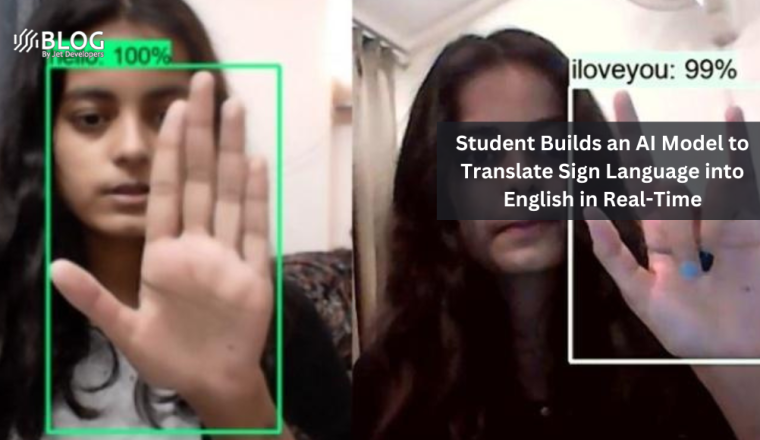
Artificial Intelligence (AI) has been used to develop various kinds of translation models to improve communication amongst users and break language barriers across regions. Companies like Google and Facebook use AI to develop advanced translation models for their services. Now, a third-year engineering student from India has created an AI model that can detect American Sign Language (ASL) and translate them into English in real-time.

Indian Student Develops AI-based ASL Detector

Priyanjali Gupta, a student at the Vellore Institute of Technology (VIT), shared a video on her LinkedIn profile, showcasing a demo of the AI-based ASL Detector in action. Although the AI model can detect and translate sign languages into English in real-time, it supports only a few words and phrases at the moment. These include Hello, Please, Thanks, I Love You, Yes, and No.

Gupta created the model by leveraging Tensorflow object detection API and using transfer learning through a pre-trained model called ssd_mobilenet. That means she was able to repurpose existing codes to fit her ASL Detector model. Moreover, it is worth mentioning that the AI model does not actually translate ASL to English. Instead, it identifies an object, in this case, the signs, and then determines how similar it is based on pre-programmed objects in its database.

In an interview with Interesting Engineering, Gupta noted that her biggest inspiration for creating such an AI model is her mother nagging her “to do something” after joining her engineering course in VIT. “She taunted me. But it made me contemplate what I could do with my knowledge and skillset. One fine day, amid conversations with Alexa, the idea of inclusive technology struck me. That triggered a set of plans,” she told the publication.

Gupta also credited YouTuber and data scientist Nicholas Renotte’s video from 2020, which details the development of an AI-based ASL Detector, in her statement.

Although Gupta’s post on LinkedIn garnered numerous positive responses and appreciation from the community, an AI-vision engineer pointed out that the transfer learning method used in her model is “trained by other experts” and it is the “easiest thing to do in AI.” Gupta acknowledged the statement and wrote that building “a deep learning model solely for sign detection is a really hard problem but not impossible.”

“Currently I’m just an amateur student but I am learning and I believe sooner or later our open-source community, which is much more experienced and learned than me, will find a solution and maybe we can have deep learning models solely for sign languages,” she further added.

You can check out Priyanjali’s GitHub page to know more about the AI model and access the relevant resources of the project. Also, let us know your thoughts about Gupta’s ASL Detector in the comments below.

ChatGPT

ChatGPT is an AI Chatbot developed by Open AI. The chatbot has a language-based model that the developer fine-tunes for human interaction in a conversational manner. 

Effectively it’s a simulated chatbot primarily designed for customer service; people use it for various other purposes too though. These range from writing essays to drafting business plans, to generating code. But what is it and what can it really do?

What is ChatGPT?

It is an AI chatbot auto-generative system created by Open AI for online customer care. It is a pre-trained generative chat, which makes use of (NLP) Natural Language Processing. The source of its data is textbooks, websites, and various articles, which it uses to model its own language for responding to human interaction.

This chatbot system provides information and responses to inquiries through AI. The popular version of ChatGPT is the GPT-3 model.

What is ChatGPT used for?

The main feature of Chat GPT is generating responses like those humans would provide, in a text box. Therefore, it is suitable for chatbots, AI system conversations, and virtual assistants. 

However, it can also give natural answers to questions in a conversational tone and can generate stories poems and more. Moreover, it can:

  • Write code 
  • Write an article or blog post
  • Translate
  • Debug
  • Write a story/poem
  • Recommend chords and lyrics

To make the AI carry out one of these demands, all you need to do is type the command into the chatbot.

What is Chat GPT Pro?

Chat GPT Pro, is a rumored professional subscription plan for OpenAI’s Chat GPT. The service was hinted to cost around $42 per month. Surprisingly, the professional plan has not yet been introduced since the reports were first spread at the start of the year.

However, OpenAI has recently released a subscription service, but under a different name – Chat GPT Plus. This plan offers users exclusive benefits including priority access and faster response times. Costing only $20 a month, this option is significantly cheaper than Pro.

What is Chat GPT trained on?

It relies on NLP (Natural Language Processing). It’s an excellent tool for researchers and developers working on various NLP projects, and it has many specific tasks, domains, and applications available to work within.

It is well-trained on biased and unbiased data, in the form of text from books, articles, and websites. Chat GPT can reproduce data outputs and reliability – crucial for many sensitive apps and other valuable Al systems. However, it is still prone to error, and biases and depends on its training data – provided in 2021.

As humans we are, more and more, interacting with Al-powered machines, and Chat GPT is a revolution in the field of Al. It is a robust model and particularly advanced thanks to its deep-learning capabilities and NLP. Ultimately, it can generate human-like answers and is easily understandable to users. Thought that doesn’t always make it right.

Can I use Chat GPT on my phone?

Yes, you can use Chat GPT on your phone. There’s nothing preventing you from doing so, as the mobile web version of the app will allow you to carry out the same actions as on a desktop browser.

Of course, you actually need a phone number for Chat GPT if you want to log in. And the ability to use it on a smartphone makes mobile use very easy – as long as you can connect.

Is there Chat GPT for Android?

There is no official Chat GPT app from Open AI, and there is no information as to whether there will be. There are purported ‘Chat GPT apps’ available in the Play Store, but these are not from the company.

Importantly, Chat GPT makes use of the GPT-3 model which is only accessible via the OpenAI Chat GPT page. But although there is no Android (or iPhone) app from OpenAI, you can access Chat GPT on your mobile device by going to the same URL.

What is Chat GPT good for?

Chat GPT is pretty good at generating text which mimics human speech. This is useful if you need a post for a website or social media page, but don’t have the time to write it out yourself. It can also produce code – again, useful if you don’t have the time to write it out yourself.